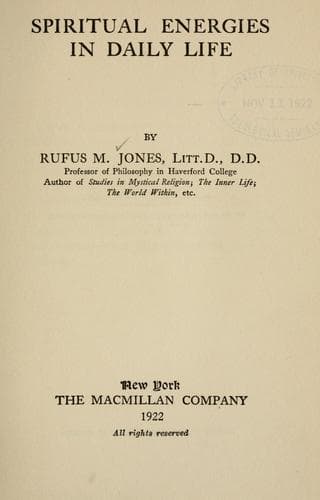
Spiritual Energies in Daily LifeJones, Rufus M. (Rufus Matthew)
Religion
Spiritual Energies in Daily Life
Jones, Rufus M. (Rufus Matthew)
Spiritual life
The sublimity and grandeur revealed in nature, the majesty of mountains,
the might of seas, the mystery of the ocean, the glory of the sun and
stars, the awe inspired by the thunderstorm, awakened man’s own spirit
and made him dimly conscious of a kindred grandeur in his own answering
soul. The greatest step of all was taken when man awoke to the meaning
and value of love. In some dim sense love preceded the emergence of man.
The evolution of a mother and of a father, as Drummond showed, began far
back in forms of life below man. But the type of love which transcends
instinct, which is raised above sex-assertion, and is transmuted into an
unselfish appreciation of the beauty and worth of personal character—that
type of love is one of the most wonderful flowers that has yet blossomed
on our Igdrasil tree of life and it was late and slow to come, like
flowers on the century-plant.
When death broke in and separated those who loved in this great fashion
the whole problem of death at once became an urgent one. In fact death
received _attention_ in proportion as the higher values of life began to
be realized. Walt Whitman’s fiery outburst reveals clearly his estimate
of the worth of personality. “If rats and maggots end us, then alarum!
for we are betrayed”—he might have said “if microbes end us.” Emerson’s
poignant outcry of soul is found in his greatest poem—“Threnody”:
“There’s not a sparrow or a wren,
There’s not a blade of autumn grain,
Which the four seasons do not tend
And tides of life and increase lend;
And every chick of every bird,
And weed and rock-moss is preferred.
O ostrich-like forgetfulness!
O loss of larger in the less!
Was there no star that could be sent,
No watcher in the firmament,
No angel from the countless host
That loiters round the crystal coast,
Could stoop to heal that only child,
Nature’s sweet marvel undefiled,
And keep the blossom of the earth,
Which all her harvests were not worth?”
Public-domain text, read in full here on John Shaqi.
Reviews
Reviews
No reviews yet
Be the first to share your thoughts on this work.
Elsewhere in the archive
Join the Discussion
Join the discussion
Sign in to leave a comment or review.
Sign InorCreate an account