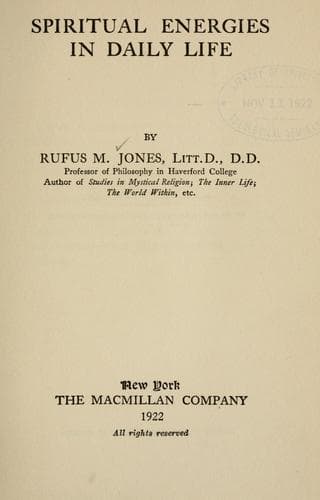
Spiritual Energies in Daily LifeJones, Rufus M. (Rufus Matthew)
Religion
Spiritual Energies in Daily Life
Jones, Rufus M. (Rufus Matthew)
Spiritual life
There are many different degrees of intensity, concentration and
conviction in the experiences of different individual mystics, and also
in the various experiences of the same individual from time to time.
There has been a tendency in most studies of mysticism to regard the
state of ecstasy as _par excellence_ mystical experience. That is,
however, a grave mistake. The calmer, more meditative, less emotional,
less ecstatic experiences of God are not less convincing and possess
greater constructive value for life and character than do ecstatic
experiences which presuppose a peculiar psychical frame and disposition.
The seasoned Quaker in the corporate hush and stillness of a silent
meeting is far removed from ecstasy, but he is not the less convinced
that he is meeting with God. For the _essentia_ of mysticism we do not
need to insist upon a certain “sacred” mystic way nor upon ecstasy,
nor upon any peculiar type of rare psychic upheavals. We do need to
insist, however, upon a consciousness of commerce with God amounting to
conviction of his presence.
“Where one heard noise
And one saw flame,
I only knew He named my name.”
Jacob Boehme calls the experience which came to him, “breaking through
the gate,” into “a new birth or resurrection from the dead,” so that, he
says, “I knew God.” “I am certain,” says Eckhart, “as certain as that I
live, that nothing is so near to me as God. God is nearer to me than I
am to myself.” One of these experiences—the first one—was an ecstasy,
and the other, so far as we can tell, was not. It was the flooding in of
a moment of God-consciousness in the act of preaching a sermon to the
common people of Cologne. The experience of Penington, again, was not
an ecstasy; it was the vital surge of fresh life on the first occasion
of hearing George Fox preach after a long period of waiting silence. A
simple normal case of a mild type is given in a little book of recent
date, reprinted from the _Atlantic Monthly_: “After a long time of
jangling conflict and inner misery, I one day, _quite quietly and with
no conscious effort_, stopped doing the dis-ingenuous thing [I had been
doing]. Then the marvel happened. It was as if a great rubber band which
had been stretched almost to the breaking point were suddenly released
and snapped back to its normal condition. Heaven and earth were changed
for me. Everything was glorious because of its relation to some great
central life—nothing seemed to matter but that life.” Brother Lawrence,
a barefooted lay-brother of the seventeenth century, according to the
testimony of the brotherhood, attained “an unbroken and undisturbed sense
of the Presence of God.” He was not an ecstatic; he was a quiet, faithful
man who did his ordinary daily tasks with what seemed to his friends
“an unclouded vision, an illuminated love and an uninterrupted joy.”
Simple and humble though he was, he nevertheless acquired, through his
experience of God, “an extraordinary spaciousness of mind.”
Public-domain text, read in full here on John Shaqi.
Reviews
Reviews
No reviews yet
Be the first to share your thoughts on this work.
Elsewhere in the archive
Join the Discussion
Join the discussion
Sign in to leave a comment or review.
Sign InorCreate an account