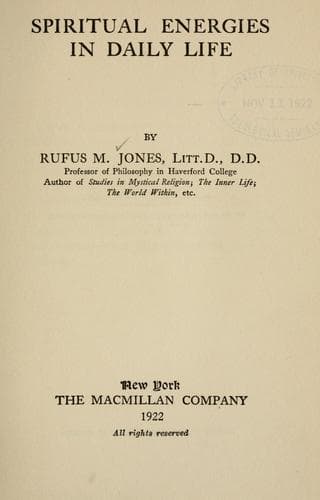
Spiritual Energies in Daily LifeJones, Rufus M. (Rufus Matthew)
Religion
Spiritual Energies in Daily Life
Jones, Rufus M. (Rufus Matthew)
Spiritual life
The more normal, expansive mystical experiences come apparently when the
personal self is at its best. Its powers and capacities are raised to an
unusual unity and fused together. The whole being, with its accumulated
submerged life, _finds itself_. The process of preparing for any high
achievement is a severe and laborious one, but nothing seems easier in
the moment of success than is the accomplishment for which the life
has been prepared. There comes to be formed within the person what
Aristotle called “a dexterity of soul,” so that the person does with ease
what he has become skilled to do. Clement of Alexandria called a fully
organized and spiritualized person “a harmonized man,” that is, adjusted,
organized and ready to be a transmissive organ for the revelation of
God. Brother Lawrence, who was thus “harmonized,” finely says, “The most
excellent method which I found of going to God was that of _doing my
common business_, purely for the love of God.” An earlier mystic of the
fourteenth century stated the same principle in these words: “It is my
aim to be to the Eternal God what a man’s hand is to a man.”
There are many human experiences which carry a man up to levels where
he has not usually been before and where he finds himself possessed of
insight and energies he had hardly suspected were his until that moment.
One leaps to his full height when the right inner spring is reached. We
are quite familiar with the way in which instinctive tendencies in us
and emotions both egoistic and social, become organized under a group
of ideas and ideals into a single system which we call a sentiment,
such as love, or patriotism, or devotion to truth. It forms slowly and
one hardly realizes that it has formed until some occasion unexpectedly
brings it into full operation, and we find ourselves able with perfect
ease to overcome the most powerful inhibitory and opposing instincts
and habits, which, until then, had usually controlled us. We are
familiar, too, with the way in which a well-trained and disciplined mind,
confronted by a concrete situation, will sometimes—alas not always—in a
sudden flash of imaginative insight, discover a universal law revealed
there and then in the single phenomenon, as Sir Isaac Newton did and
as, in a no less striking way, Sir William Rowan Hamilton did in his
discovery of Quaternions. Literary and artistic geniuses supply us with
many instances in which, in a sudden flash, the crude material at hand is
shot through with vision, and the complicated plot of a drama, the full
significance of a character, or the complete glory of a statue stands
revealed, as though, to use R. L. Stevenson’s illustration, a genie
had brought it on a golden tray as a gift from another world. Abraham
Lincoln, striking off in a few intense minutes his Gettysburg address, as
beautiful in style and perfect in form as anything in human literature,
is as good an illustration as we need of the way in which a highly
Public-domain text, read in full here on John Shaqi.
Reviews
Reviews
No reviews yet
Be the first to share your thoughts on this work.
Elsewhere in the archive
Join the Discussion
Join the discussion
Sign in to leave a comment or review.
Sign InorCreate an account