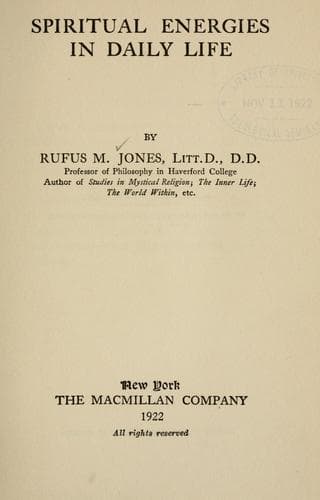
Spiritual Energies in Daily LifeJones, Rufus M. (Rufus Matthew)
Religion
Spiritual Energies in Daily Life
Jones, Rufus M. (Rufus Matthew)
Spiritual life
To some the truth of God never comes closer than a logical conclusion. He
is held to be as a living item in a creed. To the mystic he becomes real
in the same sense that experienced beauty is real, or the feel of spring
is real, or that summer sunlight is real—he has been found, he has been
met, he is present.
Before discussing the crucial question whether these experiences are
evidential and are worthy of consideration as an addition to the world’s
stock of truth and knowledge I must say a few words about the normality
or abnormality of them. Nothing of any value can be said on this point
of mystical experience in the _abstract_. One must first catch his
concrete case. Some instances are normal and some are undoubtedly
abnormal. Trance, ecstasy and rapture are unusual experiences and in
that sense not normal occurrences. They usually indicate, furthermore, a
pathological condition of personality and are thus abnormal in the more
technical sense. There is, however, something more to be said on this
point. It seems pretty well established that some persons—and they have
often been creative leaders and religious geniuses—have succeeded in
organizing their lives, in finding their trail, in charging their whole
personality with power, in attaining a moral dynamic and in tapping vast
reservoirs of energy by means of states which, if occurring in other
persons, would no doubt be called pathological. The real test here is
a pragmatic one. It seems hardly sound to call a state abnormal if it
has raised the experiencer, as a mystic experience often does, into a
hundred horse-power man and through his influence has turned multitudes
of other men and women into more joyous, hopeful and efficient persons.
This question of abnormality and reality is thus not one to be settled
off-hand by a superficial diagnosis.
An experience which brings spaciousness of mind, new interior dimensions,
ability to stand the universe—and the people in it—and capacity to
work at human tasks with patience, endurance and wisdom may quite
intelligently be called normal, though to an external beholder it
may look like what he usually calls a trance of hysteria, a state of
dissociation, or hypnosis by auto-suggestion. It should be added,
however, as I have already said, that mystical experience is not
confined to these extremer types. They may or may not be pathological.
The calmer and more restrained stages of mysticism are more important and
significant and are no more marked with the stigma of hysteria than is
love-making, enjoyment of music, devotion to altruistic causes, risking
one’s life for country, or any lofty experience of _value_.
III
Public-domain text, read in full here on John Shaqi.
Reviews
Reviews
No reviews yet
Be the first to share your thoughts on this work.
Elsewhere in the archive
Join the Discussion
Join the discussion
Sign in to leave a comment or review.
Sign InorCreate an account