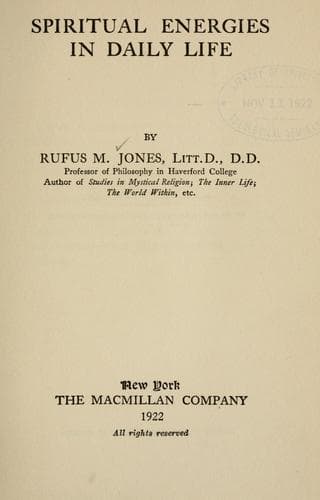
Spiritual Energies in Daily LifeJones, Rufus M. (Rufus Matthew)
Religion
Spiritual Energies in Daily Life
Jones, Rufus M. (Rufus Matthew)
Spiritual life
We come at length to the central question of our consideration: Do
mystical experiences settle anything? Are they purely subjective and
one-sided, or do they prove to have objective reference and so to be
two-sided? Do they take the experiencer across the chasm that separates
“self” from “Other”? Mystical experience undoubtedly feels as though it
had objective reference. It comes to the individual with indubitable
authority. He is certain that he has found some thing other than himself.
He has an unescapable conviction that he is in contact and commerce with
reality beyond the margins of his personal self. “A tremendous muchness
is suddenly revealed,” as William James once put it.
We do not get very far when we undertake to reduce knowledge to an
affair of sense-experience. “They reckon ill who leave me out,” can be
said by the organized, personal, creative mind as truly as by Brahma.
There are many forms of human experience in which the data of the
senses are so vastly transcended that they fail to furnish any real
explanation of what occurs in consciousness. This is true of all our
experiences of _value_, which apparently spring out of synthetic or
synoptic activities of the mind, i.e., activities in which the mind is
unified and creative. The vibrations of ether which bombard the rods and
cones of the retina may be the occasion for the appreciation of beauty
in sky or sea or flower, but they are surely not the _cause_ of it. The
concrete event which confronts me is very likely the occasion for the
august pronouncement of moral issues which my conscience makes, but it
can not be said that the concrete event in any proper sense _causes_ this
consciousness of moral obligation. The famous answer of Leibnitz to the
crude sense-philosophy of his time is still cogent. To the phrase: “There
is nothing in the mind that has not come through the senses,” Leibnitz
added, “except the mind itself.” That means that the creative activity
of the mind is always an important factor in experience and one that can
not be ignored in any of the processes of knowledge. Unfortunately we
have done very little yet in the direction of comprehending the interior
depth of the personal mind or of estimating adequately the part which
mind itself in its creative capacity plays in all knowledge functions. It
will only be when we have succeeded in getting beyond what Plato called
the bird-cage theory of knowledge to a sound theory of knowledge and
to a solid basis for spiritual values that we shall be able to discuss
intelligently the “findings” of the mystic.
Public-domain text, read in full here on John Shaqi.
Reviews
Reviews
No reviews yet
Be the first to share your thoughts on this work.
Elsewhere in the archive
Join the Discussion
Join the discussion
Sign in to leave a comment or review.
Sign InorCreate an account