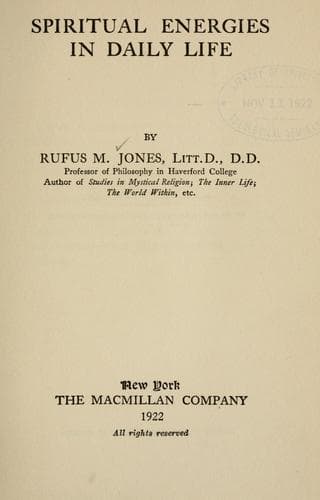
Spiritual Energies in Daily LifeJones, Rufus M. (Rufus Matthew)
Religion
Spiritual Energies in Daily Life
Jones, Rufus M. (Rufus Matthew)
Spiritual life
had an experience two years before he died which made him put his pen
and inkhorn on the shelf and never write another word of his _Summa
Theologiae_. When he was reminded of the incomplete state of his great
work and was urged to go on with it, he only replied, “I have seen that
which makes all that I have written look small to me.”
It may be just possible that there is a universe of spiritual reality
upon which our finite spirits open inward as inlets open into the sea.
“Like the tides on the crescent sea-beach
When the moon is new and thin
Into our hearts high yearnings
Come welling and surging in;
Come from that mystic ocean
Whose rim no foot has trod.
Some call it longing
But others call it God.”
Such a view is perfectly sane and tenable; it conflicts with no proved
and demonstrated facts either in the nature of the universe or of
mind. It seems anyway to the mystic that there is such a world, that
he has found it as surely as Columbus found San Salvador, and that his
experience is a truth-telling experience.
IV
But granting that it is truth-telling and has objective reference, is the
mystic justified in claiming that he has found and knows God? One does
not need to be a very wide and extensive student of mystical experience
to discover what a meager stock of knowledge the genuine mystic reports.
William James’ remarkable experience in the Adirondack woods very well
illustrates the type. It had, he says, “an intense significance of some
sort, if one could only _tell_ the significance.... In point of fact, I
can’t find a single word for all that significance and don’t know what it
was significant of, so that it remains a mere boulder of impression.”[7]
At a later date James refers to that “extraordinary vivacity of man’s
psychological commerce with something Ideal that _feels as if_ it were
also actual.”[8] The greatest of all the fourteenth century mystics,
Meister Eckhart, could not put his _impression_ into words or ideas. What
he found was a “wilderness of the Godhead where no one is at home,” i.e.,
an Object with no particular differentiated, concrete characteristics.
It was not an accident that so many of the mystics hit upon the _via
negativa_, the way of negation, or that they called their discovery “the
divine Dark.”
“Whatever your mind comes at
I tell you flat
God is not that.”
Mystical experience does not supply concrete information. It does not
bring new finite facts, new items that can be used in a description of
“the scenery and circumstance” of the realm beyond our sense horizons.
It is the awareness of a Presence, the consciousness of a Beyond, the
discovery, as James puts it, that “we are continuous with a More of the
same quality, which is operative in us and in touch with us.”
Public-domain text, read in full here on John Shaqi.
Reviews
Reviews
No reviews yet
Be the first to share your thoughts on this work.
Elsewhere in the archive
Join the Discussion
Join the discussion
Sign in to leave a comment or review.
Sign InorCreate an account