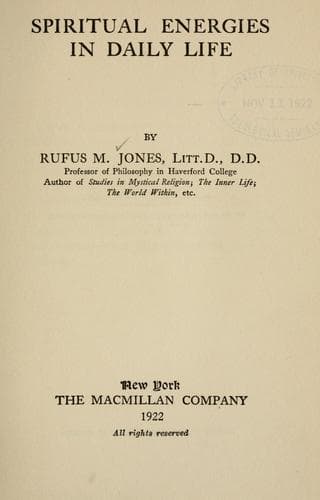
Spiritual Energies in Daily LifeJones, Rufus M. (Rufus Matthew)
Religion
Spiritual Energies in Daily Life
Jones, Rufus M. (Rufus Matthew)
Spiritual life
The world at the present moment is pitiably “short” in its stock of
sound theories of knowledge. The prevailing psychologies do not explain
knowledge at all. The behaviorists do not try to explain it any more
than the astronomer or the physicist does. The psychologist who reduces
mind to an aggregation of describable “mind-states” has started out on
a course which makes an explanation forever impossible, since knowledge
can be explained only through unity and integral wholeness, never through
an aggregation of parts, as though it were a mental “shower of shot.” If
we expect to talk about _knowledge_ and seriously propose to use that
great word _truth_, we must at least begin with the assumption of an
intelligent, creative, organizing center of self-consciousness which can
transcend itself and can _know_ what is beyond and other than itself. In
short, the talk about a “chasm” between subject and object—knower and
thing known—is as absurd as it would be to talk of a chasm between the
convex and the concave sides of a curve. Knowledge is always knowledge
of an object and mystical experience has all the essential marks of
objective reference, as certainly as other forms of experience have.
Professor J. M. Baldwin very well says that there is a form of
contemplation in which, as in æsthetic experience, the strands of
the mind’s diverging dualisms are “_merged and fused_.” He adds: “In
this experience of a fusion which is not a mixture but which issues
in a meaning of its own sort and kind, an experience whose essential
character is just this unity of comprehension, consciousness attains its
completest, its most direct, and its final apprehension of what Reality
is and means.” It really comes round to the question whether the mind of
a self-conscious person has any way of approach, except by way of the
senses, to any kind of reality. There is no _a priori_ answer to that
question. It can only be settled by experience. It is, therefore, pure
dogmatism to say, as Professor Dunlap in his recent attack on mysticism
does, that all conscious processes are based on sense-stimulation and
all thought as well as perception depends on reaction to sense-stimulus.
It is no doubt true that behavior psychology must resort to some such
formula, but that only means that such psychology is always dealing
with greatly transformed and reduced beings, when it attempts to deal
with persons like us who, in the richness of our concrete lives, are
never reduced to “behavior-beings.” We have interior dimensions and that
is the end on’t! Some persons—and they are by no means feeble-minded
individuals—are as certain that they have commerce with a world within
as they are that they have experiences of a world outside in space.
Thomas Aquinas, who neither in method nor in doctrine leaned toward
mysticism, though he was most certainly “a harmonized man,” and who in
theory postponed the vision of God to a realm beyond death, nevertheless
Public-domain text, read in full here on John Shaqi.
Reviews
Reviews
No reviews yet
Be the first to share your thoughts on this work.
Elsewhere in the archive
Join the Discussion
Join the discussion
Sign in to leave a comment or review.
Sign InorCreate an account