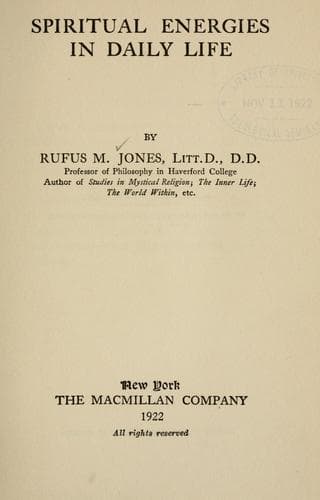
Spiritual Energies in Daily LifeJones, Rufus M. (Rufus Matthew)
Religion
Spiritual Energies in Daily Life
Jones, Rufus M. (Rufus Matthew)
Spiritual life
When Columbus found San Salvador he was able to describe it to those who
did not sail with him in the Santa Maria, but when the mystic finds God
he can not give us any “knowledge” in plain words of everyday speech. He
can only refer to his boulder, or his Gibraltar, of _impression_ That
situation is what we should expect. We can not, either, describe any of
our great emotions. We can not impart what flushes into our consciousness
in moments of lofty intuition. We have a submerged life within us which
is certainly no less real than our hand or foot. It influences all that
we do or say, but we do not find it easy to utter it. In the presence of
the sublime we have nothing to say—or if we do say anything it is a great
mistake! Language is forged to deal with experiences which are common
to many persons, i.e., to experiences which refer to objects in space.
We have no vocabulary for the subtle, elusive flashes of vision which
are unique, individual and unsharable, as for instance is our personal
sense of “the tender grace of a day that is dead.” We are forced in all
these matters to resort to symbolic suggestion and to artistic devices.
Coventry Patmore said with much insight:
“In divinity and love
What’s best worth saying can’t be said.”
I believe that mystical experiences do in the long run expand our
knowledge of God and do succeed in verifying themselves. Mysticism is a
sort of spiritual protoplasm that underlies, as a basic substance, much
that is best in religion, in ethics and in life itself. It has generally
been the mystic, the prophet, the seer that has spotted out new ways
forward in the jungle of our world, or lifted our race to new spiritual
levels. Their experiences have in some way equipped them for unusual
tasks, have given supplies of energy to them which their neighbors did
not have, and have apparently brought them into vital correspondence with
dimensions and regions of reality that others miss. The proof that they
have found God, or at least a domain of spiritual reality, does not lie
in some new stock of knowledge, not in some gnostic secret, which they
bring back; it is to be seen rather in the moral and spiritual fruits
which test out and verify the experience.
Public-domain text, read in full here on John Shaqi.
Reviews
Reviews
No reviews yet
Be the first to share your thoughts on this work.
Elsewhere in the archive
Join the Discussion
Join the discussion
Sign in to leave a comment or review.
Sign InorCreate an account