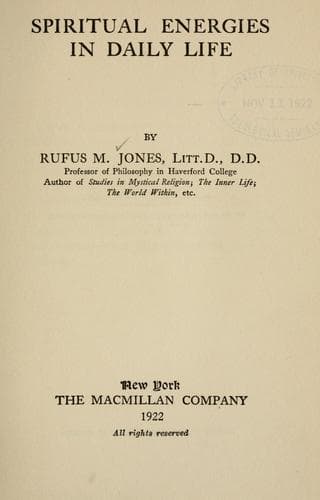
Spiritual Energies in Daily LifeJones, Rufus M. (Rufus Matthew)
Religion
Spiritual Energies in Daily Life
Jones, Rufus M. (Rufus Matthew)
Spiritual life
Consciousness of beauty or of truth or of goodness baffles analysis
as much as consciousness of God does. These values have no objective
standing ground in current psychology. They are not things in the world
of space. They submit to no adequate casual explanation. They have their
ground of being in some other kind of world than that of the mechanical
order, a world composed of quantitative masses of matter in motion. These
experiences of value, which are as real for consciousness as stone walls
are, make very clear the fact that there are depths and capacities in
the nature of the normal human mind which we do not usually recognize
and of which we have scant and imperfect accounts in our text-books.
Our minds taken in their full range, in other words, have some sort of
contact and relationship with an eternal nature of things far deeper than
atoms and molecules. Only very slowly and gradually has the race learned
through finite symbols and temporal forms to interpret beauty and truth
and goodness which in their essence are as ineffable and indescribable
as the mystic’s experience of God is. Plato often speaks as though he
had high moments of experience when he rose to the naked vision of
beauty—beauty “alone, separate and eternal,” as he says, and his myths
are very likely told, as J. A. Stewart believes, to assist others to
experience this same vision—a beauty which “does not grow nor perish,
is without increase or diminution and endures for everlasting.” But as
a matter of fact, however exalted heavenly and enduring beauty may be
in its essence we know _what it is_ only as it appears in fair forms of
objects, of body, of soul, of actions; in harmonious blending of sounds
or colors; in well-ordered or happily-combined groupings of many aspects
in one unity which is as it ought to be. Truth and moral goodness always
transcend our attainments and we sometimes feel that the very end and
goal of life is the pursuit of that truth or that goodness which eye
hath not seen nor ear heard. But whatever truth we do attain or whatever
goodness we do achieve is always concrete. Truth is just this one more
added fact that resists all attempts to doubt it. Goodness is just this
simple everyday deed that reveals a heroic spirit and a brave venture of
faith in the midst of difficulties. So, too, the mystic knowledge of God
is not some esoteric communication, supplied through trance or ecstasy;
it is an intuitive personal touch with God, felt to be the essentially
real, the bursting forth of an intense love for him which heightens all
the capacities and activities of life, followed by the slow laboratory
results which verify it. “All I could never be” now is. It seems possible
to stand the universe—even to do something toward the transformation
of it. The bans are read for that most difficult of all marriages, the
marriage of the possible with the actual, the ideal with the real. And
if the experience does not prove that the soul has found God, it at
Public-domain text, read in full here on John Shaqi.
Reviews
Reviews
No reviews yet
Be the first to share your thoughts on this work.
Elsewhere in the archive
Join the Discussion
Join the discussion
Sign in to leave a comment or review.
Sign InorCreate an account