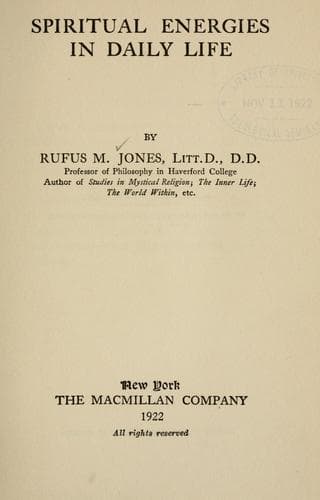
Spiritual Energies in Daily LifeJones, Rufus M. (Rufus Matthew)
Religion
Spiritual Energies in Daily Life
Jones, Rufus M. (Rufus Matthew)
Spiritual life
Two of the main tendencies in what is usually called scientific
psychology are (1) the “behaviorist” tendency and (2) the tendency to
reduce the inner life to a series of “mind states.” Let us consider
behaviorism first. This turns psychology into “a purely objective
experimental branch of natural science.”[9] It aims at “the prediction
and control of behavior.” “Introspection forms no essential part of
its method.” One is not concerned with “interpretation in terms of
consciousness,” one is interested only in reactions, responses—in short,
in _behavior_ in the presence of stimuli which produce movements. The
body is a complicated organ and “mind” is merely a convenient term to
express its “activities.”[10] The behaviorist “recognizes no dividing
line between man and brute.” Psychology becomes “the science of
behavior,”[11] the study of “the activity of man or animal as it can be
observed from the outside, either with or without attempting to determine
the mental states by inference from these acts.” Emotions become reduced
forthwith to “the bodily resonance” set up in the muscular and visceral
systems by instinctive movements in the presence of objects, these
curious movements being due entirely to the inheritance of physiological
structure adapted at least in the early stages to aid survival. There is
no way by which behaviorist psychology can give any standing to religion
or to any type of spiritual values. “Æsthetics is the study of the
useless,” as William James baldly states the case. Conscience disappears
or becomes another name for the inheritance or acquisition of certain
types of social behavior. Everything which we call ethics or morality
changes into well-defined and rigidly determined behavior. There is
nothing more “spiritual” about it than there is in the fall of a raindrop
or in the luminous trail of a meteor, or in any form of what has happily
been called “cosmic weather.”
This reduction of personality to a center of activity is a reaction from
the dualistic sundering of mind and body inherited from Descartes. The
theory of psycho-physical parallelism is utterly bankrupt. Idealism,
which is an attempt to get round the _impasse_ of dualism by treating
mind as the only reality, is abhorrent to scientists and unpopular
with young philosophers, especially in America. Some other solution
is therefore urgent. The easiest one at hand, though it is obviously
temporary and superficial, is to cut across the mind loop, ignore its
unique, originative, creative capacity and its interior depth, to deal
only with body plus body’s activities, and to call that “psychology.”
Public-domain text, read in full here on John Shaqi.
Reviews
Reviews
No reviews yet
Be the first to share your thoughts on this work.
Elsewhere in the archive
Join the Discussion
Join the discussion
Sign in to leave a comment or review.
Sign InorCreate an account