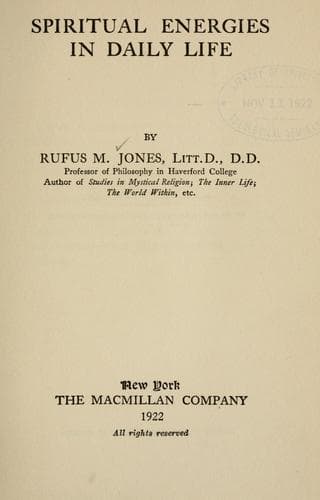
Spiritual Energies in Daily LifeJones, Rufus M. (Rufus Matthew)
Religion
Spiritual Energies in Daily Life
Jones, Rufus M. (Rufus Matthew)
Spiritual life
The “mind-state” psychology takes us little farther on. It also is a
form of naturalism. “Mind-state” psychology makes more of introspection
than behaviorist psychology does, and it works more than the latter
does in terms of consciousness, which for the behaviorist can be almost
ignored or questioned as an existing reality. According to this view,
mind or consciousness is composed of a vast number of “elemental units,”
and the business of psychology is to analyze and describe these units
or states and to discover the laws of their arrangement or succession.
Mind, on this theory, is an aggregate or sum total of “states.” Professor
James, who gives great place to “mind states,” will, however, not admit
that they are permanent and repeatable “units,” passing and returning
unaltered. In his usual vivid way he says that “a permanently existing
‘idea’ [i.e., mental unit] which makes its appearance before the
footlights of consciousness at periodical intervals is as mythological
an entity as the Jack of Spades.”[12] And yet he continues to deal with
mind as a vast series of more or less describable states. Some states are
“substantive,” such as our “perceptions,” our “memories,” or our definite
“images,” when the mind perches and rests upon some clear and describable
thought, and on the other hand there are “transitive states” which are
vague, hard to catch or hold or express, and which reveal the mind in
flight, in passage, on the way from one substantive state to another.
When we ask the “mind-state” psychologist to tell us about the soul or to
supply us with a working substitute for it, he relegates it to the scrap
heap where lie the collected rubbish and the antiquated mental furniture
of the medieval centuries. We have no need of it. It is only a _word_
anyhow. It has always been an expensive luxury and a continual bother. We
are better off with it gone. When we look about for a “self as knower,”
or for a guardian of our identity, we find all that we need in these same
“passing states of consciousness.” They not only know things and facts,
but they also know themselves, and successively inherit and adapt all the
preceding “states” have gained and acquired. The state of the present
moment owns the thoughts and experiences which preceded it, for “what
possesses the possessor possesses the possessed.” “In our waking hours,”
Professor James says, “though each pulse of consciousness dies away and
is replaced by another, yet that other, among the things it knows, knows
its own predecessor and finding it ‘warm,’ greets it saying, ‘Thou art
_mine_ and part of the same self with me.’” It seems, then, this famous
writer concludes, that “states of consciousness are all that psychology
needs to do her work with. Metaphysics or theology may prove the soul to
exist; but for psychology the hypothesis of such a substantial principle
of unity is superfluous.”[13] We are certainly hard up if we must depend
on proofs which theology can give us!
Public-domain text, read in full here on John Shaqi.
Reviews
Reviews
No reviews yet
Be the first to share your thoughts on this work.
Elsewhere in the archive
Join the Discussion
Join the discussion
Sign in to leave a comment or review.
Sign InorCreate an account