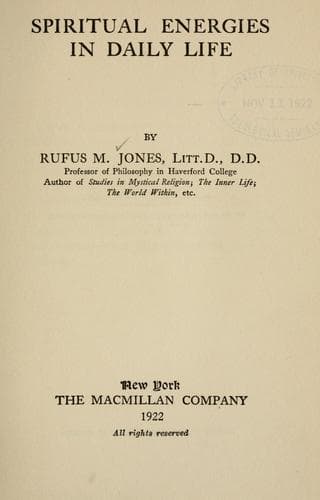
Spiritual Energies in Daily LifeJones, Rufus M. (Rufus Matthew)
Religion
Spiritual Energies in Daily Life
Jones, Rufus M. (Rufus Matthew)
Spiritual life
In the same vein Pringle-Pattison, one of the wisest of our living
teachers, has said:
“Consciousness of imperfection, the capacity for progress,
and the pursuit of perfection, are alike possible to man only
through the universal life of thought and goodness in which
he shares and which, at once an indwelling presence and an
unattainable ideal, draws him ‘on and always on.’”[15]
It is here in these experiences of ours which spring out of our real
nature, but which always carry us beyond _what is_ and which make it
impossible for us to live in a world composed of “things,” no matter
how golden they are, that we have the source of our spiritual values.
When we talk about values we may use the word in two senses. In the
ordinary sense we mean something extrinsic, utilitarian. We mean that
we possess something which can be exchanged for something else. It is
precious because we can sell it or swap it or use it to keep life going.
In the other sense we see value in reference to something which _ought
to be_, whether it now is or not. It is _fit_ to be, it would justify
its being in relation to the whole reality. When we speak of ethical or
spiritual values we are thinking of something that will minister to the
highest good of persons or of a society of persons. Value in this loftier
meaning always has to do with ideals. A being without any conscious
end or goal, i.e., without an ideal, would have no sense of worth, no
spiritual values. It does not appear on the level of instinct. It arises
as an appreciation of what ought to be realized in order to complete and
fulfill any life which is to be called good. Obviously a person with
rich and complex interests will have many scales of value, but lower and
lesser ones will fall into place under wider and higher ones, so that one
forms a kind of hierarchical system of values with some overtopping end
of supreme worth dominating the will.
Public-domain text, read in full here on John Shaqi.
Reviews
Reviews
No reviews yet
Be the first to share your thoughts on this work.
Elsewhere in the archive
Join the Discussion
Join the discussion
Sign in to leave a comment or review.
Sign InorCreate an account