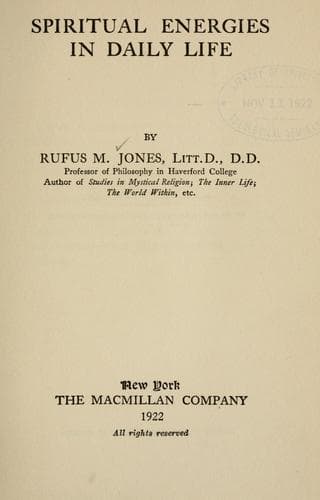
Spiritual Energies in Daily LifeJones, Rufus M. (Rufus Matthew)
Religion
Spiritual Energies in Daily Life
Jones, Rufus M. (Rufus Matthew)
Spiritual life
What we find at once, even without a resort to a subliminal self, or to
“uprushes,” is that our normal, personal self-consciousness is a unique,
living, self-active, creative center of energies, dealing not only with
space and time and tangible things, but dealing as well with realities
which are space- and time-transcending. “The things that are not” prove
to be immense factors in our lives and constantly “bring to naught the
things that are.” The greatest events of history have not been due to
physical forces; they have been due to plans and ideals which were real
only in the viewless minds of men. What _was not yet_ brought about what
was to be. Alexander the Great with his physical forces, sweeping across
the ancient world like a cataclysm of nature, was certainly no more truly
a world-builder than was Jesus, who had no armies, who used no tangible
forces, but merely put into operation those “things that were not,” i.e.,
his ideas of what ought to be and his conviction that love is stronger
than Roman legions. The simplest and humblest of us, like the Psalmist,
find the Meshech where we sojourn too straitened and narrow for us. We
have all cried, “Woe is me that I sojourn in Meshech!” The reason that
we discover the limits and bounds of our poor Meshech is that we are all
the time going beyond the hampering Meshech that tries to contain and
imprison us.
The thing which spoils all our finite camping places is our unstilled
consciousness that we are made for something more than we have yet
realized or attained. Our ideals are an unmistakable intimation of our
time-transcending nature. We can no more stop with _that which is_ than
Niagara can stop at the fringe of the fall. All consciousness of the
higher rational type is continually carried forward toward the larger
whole that would complete and fulfill its present experience. We are
aware of the limit only because we are already beyond it. The present is
a pledge of more; the little arc which we have gives us a ground of faith
in the full circle which we seek. A study of man’s life which does not
deal with this inherent idealizing tendency is like _Hamlet_ with Hamlet
left out. Martineau declared:
“Amid all the sickly talk about ‘ideals’ which has become the
commonplace of our age, it is well to remember that so long
as they are dreams of future possibility and not faiths in
present realities, so long as they are a mere self-painting
of the yearning spirit and not its personal surrender to
immediate communion with an infinite Perfection, they have no
more solidity or steadiness than floating air-bubbles, gay in
the sunshine and broken by the passing wind.... The very gate
of entrance to religion, the moment of its new birth, is the
discovery that your ideal is the everlasting Real, no transient
brush of a fancied angel wing, but the abiding presence and
persuasion of the Soul of souls.”[14]
Public-domain text, read in full here on John Shaqi.
Reviews
Reviews
No reviews yet
Be the first to share your thoughts on this work.
Elsewhere in the archive
Join the Discussion
Join the discussion
Sign in to leave a comment or review.
Sign InorCreate an account