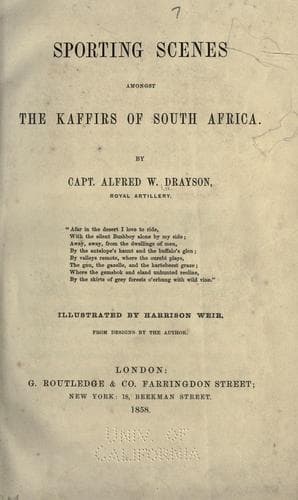
Sporting Scenes amongst the Kaffirs of South AfricaDrayson, Alfred W. (Alfred Wilks)
History
Sporting Scenes amongst the Kaffirs of South Africa
Drayson, Alfred W. (Alfred Wilks)
Hunting -- South Africa; South Africa -- Description and travel
Now let us see if the treatment of the Kaffirs of Natal is very
different from this. It must be borne in mind that the poor heathen, in
addition to his natural _amor patria_, believes firmly that the spirits
of his fathers are watching over him from the hills that they have
during life inhabited; and that if he quits those hills, he, in a
measure, withdraws from their care. The Journal of the Bishop of Cape
Town, dated June 9th, 1850, states: "I have heard to-day from a lady who
lives in the neighbourhood, that the chief, Umnini, of whom I have
before spoken, removed from his lands on the Bluff (Natal) last Friday.
He came to bid her farewell before he left; for they had been kind
neighbours to each other. It was not without sorrow that he quitted his
birthplace, where he has resided all his life, and withstood in his
fastnesses the victorious troops of Tshaka, who conquered the whole
country, and brought into subjection all the native chiefs, except this
one and another. But now we want his land; it is important for our
growing settlement at D'Urban that it should be in our possession;
therefore he must go. He is weak and we are strong." Although it is
not sacrilege to suppose a bishop might be mistaken, still we will ask
which of the two following is the more probable case:--
That the Lord Bishop of Cape Town knew perfectly well what he was
writing about, had good information of the facts he mentioned, and
merely forbore from using stronger language on account of his holy
character; or, that he was quite wrong altogether, and was mistaken with
regard to the affair?
_Might_ it not have been Umnini's own wish that caused him to quit the
land on which he had dwelt for half a century? _Could_ it not have been
that he at last came to consider the soil that had drunk the blood of
his warriors who died in defending it from the attacks of the savage
Tshaka, as desecrated by the act instead of hallowed? Or did he not
consider that _though hundreds of moons_ had shone upon him and his
fathers in this place, future moons ought hereafter to shine upon him in
a less fertile soil; and therefore, agreeing to the white man's wishes,
he _willingly_ quitted his home for the price of a few head of cattle
and went forth a wanderer?
As to our strength and the Kaffirs' weakness--oh, no! those things never
happen here; if they did, some might ask, with the innocence of the
child in the show, which was the uncultivated savage famous for "a
compound of treachery and cunning," and which the Christian. The same
ambiguous answer might naturally be returned, "that we had paid our
money and might take our choice."
These proceedings are all very well, if we look merely to this world as
all and everything; but when we think of the next, the reflection is
hardly so satisfactory.
Public-domain text, read in full here on John Shaqi.
Reviews
Reviews
No reviews yet
Be the first to share your thoughts on this work.
Elsewhere in the archive
Join the Discussion
Join the discussion
Sign in to leave a comment or review.
Sign InorCreate an account