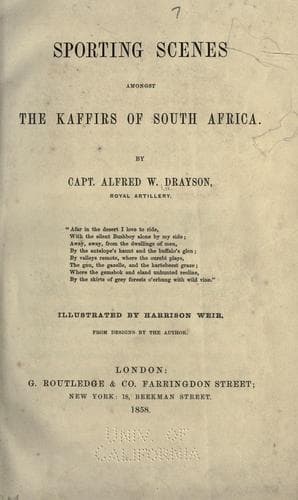
Sporting Scenes amongst the Kaffirs of South AfricaDrayson, Alfred W. (Alfred Wilks)
History
Sporting Scenes amongst the Kaffirs of South Africa
Drayson, Alfred W. (Alfred Wilks)
Hunting -- South Africa; South Africa -- Description and travel
But who is wrong? Surely it is not the soldier, who merely goes to see
that the orders given to him are carried out. The Colonial Government
will say it is not they that are to blame, as land must be had. And it
certainly is not the English Government that should bear the onus. It
appears that amongst many of the officials of South Africa, there is a
practice of adhering to the letter of the law, instead of the spirit;
that is in strict accordance with the character shown by the soldier,
who did not save a woman from drowning when he was close beside her,
because he had been taught not to act without orders, and there was
nothing in the Articles of War about drowning women.
Let it not be supposed for a moment that I agree with those who are ever
crying, "Do away with the soldiers," or "Spare the poor savage from
punishment." When we have to deal with the ferocious savage, whether he
is so naturally or has been made so by the mistaken policy of our
forefathers, it is nothing but the strong arm and the firm hand that can
and will ever keep him in subjection or prevent him from being a
murderer and confirmed thief.
Soldiers may be an evil, but so are doctors; and whenever the disease
war breaks out, it must be vigorously attacked by the physicians, in the
shape of soldiers; and the more ably and the better these soldiers
attack the disease, the sooner will it be stopped, and the less frequent
will be its recurrence. It would be as ridiculous and short-sighted a
policy to send away all the doctors, hoping thereby to stop sickness, as
to weaken our force anywhere in any country, by withdrawing or reducing
its army, in the hope of better maintaining peace.
The savage invariably considers that forbearance in war is caused by
fear, and he is more ready and eager for battle after kindness and mercy
have been shown him than he would be after a severe lesson. The Kaffir,
when he really is a savage, is a most ferocious one; and although the
distance that separates England from the Cape is so great, that events
taking place there are scarcely discernible; still, they would cause a
great stir did they happen nearer. Twelve hundred men, the number slain
by these savages in the last war, would look a large body in Hyde Park.
The same policy that punishes and subdues the aroused and vindictive
Kaffir, ought to encourage and sympathise with him when he is quietly
and peaceably disposed.
Public-domain text, read in full here on John Shaqi.
Reviews
Reviews
No reviews yet
Be the first to share your thoughts on this work.
Elsewhere in the archive
Join the Discussion
Join the discussion
Sign in to leave a comment or review.
Sign InorCreate an account