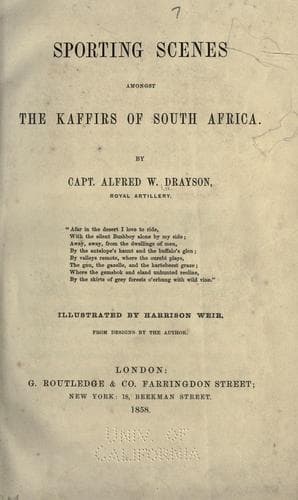
Sporting Scenes amongst the Kaffirs of South AfricaDrayson, Alfred W. (Alfred Wilks)
History
Sporting Scenes amongst the Kaffirs of South Africa
Drayson, Alfred W. (Alfred Wilks)
Hunting -- South Africa; South Africa -- Description and travel
Since penning the preceding pages, I have read a work on Natal and the
eastern frontier of the Cape Colony, by the Rev. William Holden, who was
living at D'Urban during my pilgrimage in the same neighbourhood. As he
was an excellent Kaffir linguist, and was always spoken of by Kaffirs
and white men with respect and affection, it is gratifying to find that
his fifteen years of experience bring him to the same conclusions, with
regard to the treatment of the Kaffirs, at which I may be considered to
have jumped hastily after only three years' investigation. I will quote
from page 215 of his work:--
"But let not those who are invested with a little brief authority use it
in playing all sorts of fantastic tricks, or something worse. A Kaffir
has a sharp sense of justice, and whilst he will respect and reverence
the officer who will give him just punishment for his misdeeds, he will
abhor the man who does him wanton wrong, and may be tempted to settle
accounts in his own way.
"The Kaffirs must be treated like children. If a man has a large
family, and leaves them without restraint or control, his children
become a plague to himself and a scourge to the community. The Kaffirs
are children of a larger growth, and must be treated accordingly;
_children_ in knowledge, ignorant of the relationships of civilised
society, and strangers to many of the motives which influence the
conduct of the white man. But they are _men_ in physical and mental
powers; _men_ in the arts and usages of their nation, and the laws of
their country; and the great difficulty in governing them is, to treat
them as men-children, teaching them that to submit and to obey are
essential to their own welfare as well as to that of others.
"Some kind-hearted Christians will say, `This is much too severe;' but
my firm conviction, after many years' experience, is, that it is not
merely the best, but also the only way to save the native races from
ruin and annihilation; and that, had the Kaffirs on the frontier of the
old colony been treated with more apparent severity after the first war,
a second outbreak would not have taken place. Who, I would ask, is
their best friend, the man who would save them by apparent severity, or
the man who would destroy them by mistaken kindness? I presume the
former. Besides, it should not be forgotten that what appears to be
severe to us is not so to them, since many of them have lived under the
iron rule of cruel capricious despots, with no security for fife or
property, and are consequently unable to appreciate or understand our
excess of civilised kindness; being strangers to those refined feelings
which operate in the breast of the Christian. The result of too mild a
policy is, that in a few years they are changed from crouching,
terror-stricken vassals, to bold, lawless, independent barbarians."
Public-domain text, read in full here on John Shaqi.
Reviews
Reviews
No reviews yet
Be the first to share your thoughts on this work.
Elsewhere in the archive
Join the Discussion
Join the discussion
Sign in to leave a comment or review.
Sign InorCreate an account