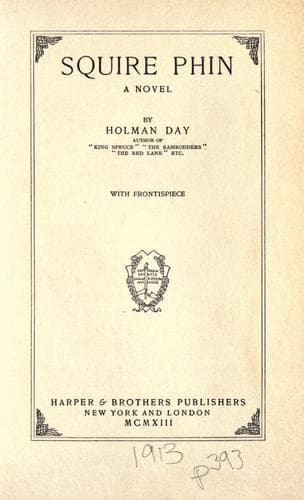
Circus -- Fiction; Maine -- Social life and customs -- Fiction; Villages -- Fiction
For a little space there was utter silence in the barn---Imogene
evidently listening in an attempt to determine whether this new arrival
were friend or foe. Then there sounded joyful trumpetings as the
exhausted and frightened animal recognised her master. The men could
hear Hiram’s voice soothing her, and after a time he appeared at the
tie-up door.
“I’ve got another time and place,” he said, addressing them as they came
crowding up to him, “for tellin’ you all what I think of a parsul of men
that will chase a poor elephant nearly to death. I ain’t goin’ to tell
you now. I’ve been runnin’ too long. I ain’t got breath enough. When I
start in to tell you I shall need a lot of it.”
“Well, we got your brother Phin’s word to come after her,” said one
of the bystanders, sulkily. “There ain’t any of us got any partic’lar
relish for an el’phunt bee, but we come ’cause he asked us to.”
“You may be good barn-raisers,” returned the showman angrily, “but what
you snoozers don’t know about elephants would make up the most that’s so
about ’em.”
Several women came to the door of the house and one of the men called to
them:
“Tell Mis’ Snell that the man that owns the animile has come to git her.
There ain’t no more danger.”
The mournings within ceased promptly and a plump and fair matron
appeared among the women on the door-stoop.
“What have you got to say for yourself, lettin’ loose such critters
to ruin and destroy?” she demanded, with the ready and hot anger that
succeeds fright.
Hiram, still framed in the tie-up door, took off his hat gallantly.
“It ain’t any doin’s of mine, marm,” he said. “Prob’ly a kinder or
sweeter-tempered elephant than Imogene is has never teased for peanuts
over a guard-rope. But it don’t improve no dispositions to be chased by
a pack of goramuses--it wouldn’t improve your disposition, it wouldn’t
improve mine.”
“Don’t you go to classin’ me with your menagerie, yourself included,”
she snapped. “What I want to know is, who’s goin’ to pay me for the
damage that’s been done here to-day? It ain’t goin’ to be no shillin’
and a thank-ye settlement, now, I can tell ye that.”
Hiram came out of the tie-up door and trudged forward a few steps.
“I’m a widder, but you needn’t think you are goin’ to jew me one cent’s
wuth,” she flung at him.
“I’ve got forty thousand dollars in the bank, and I don’t care who knows
the same,” retorted Hiram, “and I stand good for all bills incurred by
me or Imogene--now don’t you forget that for a second.”
He started across the yard toward the widow, for this arm’s-length
conversation, with so many eavesdroppers, annoyed him. The persecuted
Imogene had been trying to squeeze through the narrow alley from the
barn floor. Now that she had recovered her friend and defender she did
not propose to lose him again. With an eagerness candid and child-like,
she sought safety at his side.
Public-domain text, read in full here on John Shaqi.
Reviews
Reviews
No reviews yet
Be the first to share your thoughts on this work.
Elsewhere in the archive
Join the Discussion
Join the discussion
Sign in to leave a comment or review.
Sign InorCreate an account