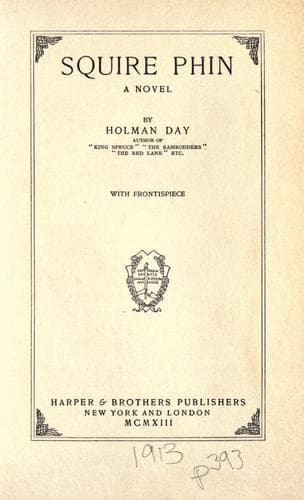
Circus -- Fiction; Maine -- Social life and customs -- Fiction; Villages -- Fiction
“Let’s see,” he began, a keen glint in his movable eye, “isn’t there a
cheap lawyer in this place named Phineas Look?”
The movable eye fell upon Squire Phin. It glittered for an instant more
brightly. The muscles of the hard face seemed to twitch a little. But he
said no more, and with a curious intentness awaited a reply.
The Squire had started at the sound of the stranger’s voice. Then he
shoved his hands deep into his trousers pockets and stared hard at the
man, his brows knotting slowly, as though he were endeavouring to recall
something.
“I don’t know who you be, nor where you come from, nor I don’t care,”
snapped Amazeen; “but I want to say to you, mister, that you’d better
call the leadin’ man in P’lermo by a different name, ’specially when
he’s standin’ here in hearin’!” He shook an indignant cane at the man
and swung and pointed it at Phineas.
At this instant a raucous voice squalled a long, loud “Yah-h-h!” A cage
was hung to one of the figures of the big waggon, whose seats showed a
former use as a band chariot. A ragged, gray parrot was in the cage. He
clutched a bar in his warty claws, rapped his bill violently and yelled:
“Crack ’em down, gents! It’s the old army game!”
The Squire took a quick step forward, halted and stared again.
“Twenty can play as well as one!” the parrot squawked. The stranger
began to clamber down from the seat and stood revealed as a tall man
when he stood upright. The knots smoothed out of the Squire’s brow.
The two men walked slowly toward one another, each with hand
outstretched, and they met half way. Hand clutched hand in a grip
that made the cords ridge the skin. They gazed for a long time with
moistening eyes.
“Hime!” choked out the Squire.
“You poor little cuss, Phin,” the other gulped, as he reached his arm
over the Squire’s shoulder and patted his back.
There was rough affection in the gesture, but there was constraint in
the stranger’s mien. He displayed the nervous bravado of one who is
ashamed and feels that the shame is a weakness.
“I ain’t come home expectin’ that you’re goin’ to treat me anyways like
a brother, Phin,” he muttered brokenly. “I ain’t ever been any good to
the family. I----”
“Don’t say that, brother Hiram! Don’t!” pleaded the Squire.
“But it’s the God’s truth, Phin. I don’t even know whether
father’s--whether he’s----” He stood back and raised entreating eyes
to his brother’s face. “You needn’t say it, Phin, boy,” he went on
mournfully. “All I can do is thank God that father had one boy that he
didn’t have to be ashamed of. I don’t ask you to overlook it--any of it,
Phin. I don’t expect you to do it. I ain’t come back for it.”
The old men had been slowly straggling down from the platform, still
busied with their survey of this amazing new arrival.
The Squire glanced around at them and spoke guardedly. His tone was
gently reproachful.
“Not a word from you or of you for twenty-five years! Hime, I never
understood that. Father didn’t understand it!”
Public-domain text, read in full here on John Shaqi.
Reviews
Reviews
No reviews yet
Be the first to share your thoughts on this work.
Join the Discussion
Join the discussion
Sign in to leave a comment or review.
Sign InorCreate an account