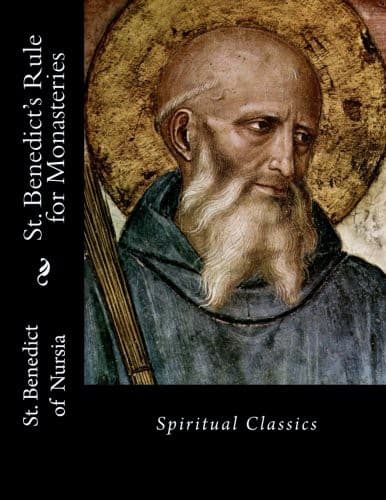
St. Benedict's Rule for MonasteriesBenedict, Saint, Abbot of Monte Cassino
Religion
St. Benedict's Rule for Monasteries
Benedict, Saint, Abbot of Monte Cassino
Benedictines -- Rules
Such as these, therefore, immediately leaving their own affairs and
forsaking their own will, dropping the work they were engaged in and
leaving it unfinished, with the ready step of obedience follow up with
their deeds the voice of him who commands. And so as it were at the same
moment the master’s command is given and the disciple’s work is
completed, the two things being speedily accomplished together in the
swiftness of the fear of God by those who are moved with the desire of
attaining life everlasting. That desire is their motive for choosing the
narrow way, of which the Lord says, “Narrow is the way that leads to
life,” so that, not living according to their own choice nor obeying
their own desires and pleasures but walking by another’s judgment and
command, they dwell in monasteries and desire to have an Abbot over
them. Assuredly such as these are living up to that maxim of the Lord in
which He says, “I have come not to do My own will, but the will of Him
who sent Me.”
Jan. 23—May 24—Sept. 23
But this very obedience will be acceptable to God and pleasing to men
only if what is commanded is done without hesitation, delay,
lukewarmness, grumbling, or objection. For the obedience given to
Superiors is given to God, since He Himself has said, “He who hears you,
hears Me.” And the disciples should offer their obedience with a good
will, for “God loves a cheerful giver.” For if the disciple obeys with
an ill will and murmurs, not necessarily with his lips but simply in his
heart, then even though he fulfil the command yet his work will not be
acceptable to God, who sees that his heart is murmuring. And, far from
gaining a reward for such work as this, he will incur the punishment due
to murmurers, unless he amend and make satisfaction.
CHAPTER 6
On the Spirit of Silence
Jan. 24—May 25—Sept. 24
Let us do what the Prophet says: “I said, ‘I will guard my ways, that I
may not sin with my tongue. I have set a guard to my mouth.’ I was mute
and was humbled, and kept silence even from good things.” Here the
Prophet shows that if the spirit of silence ought to lead us at times to
refrain even from good speech, so much the more ought the punishment for
sin make us avoid evil words.
Therefore, since the spirit of silence is so important, permission to
speak should rarely be granted even to perfect disciples, even though it
be for good, holy, edifying conversation; for it is written, “In much
speaking you will not escape sin,” and in another place, “Death and life
are in the power of the tongue.”
For speaking and teaching belong to the master; the disciple’s part is
to be silent and to listen. And for that reason if anything has to be
asked of the Superior, it should be asked with all the humility and
submission inspired by reverence.
Public-domain text, read in full here on John Shaqi.
Reviews
Reviews
No reviews yet
Be the first to share your thoughts on this work.
Join the Discussion
Join the discussion
Sign in to leave a comment or review.
Sign InorCreate an account