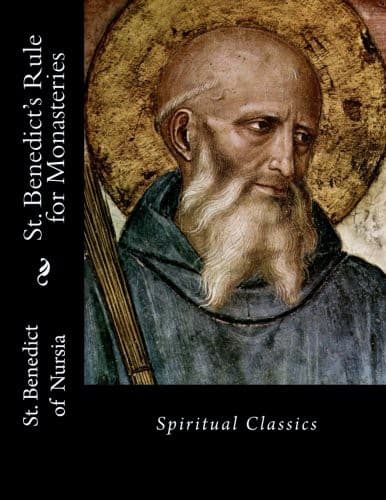
St. Benedict's Rule for MonasteriesBenedict, Saint, Abbot of Monte Cassino
Religion
St. Benedict's Rule for Monasteries
Benedict, Saint, Abbot of Monte Cassino
Benedictines -- Rules
After these let there be three canticles from the book of the Prophets,
as the Abbot shall appoint, and let these canticles be chanted with
“Alleluia.” Then when the verse has been said and the Abbot has given
the blessing, let four more lessons be read, from the New Testament, in
the manner prescribed above.
After the fourth responsory let the Abbot begin the hymn “We praise You,
O God.” When this is finished the Abbot shall read the lesson from the
book of the Gospels, while all stand in reverence and awe. At the end
let all answer “Amen,” and let the Abbot proceed at once to the hymn “To
You be praise.” After the blessing has been given, let them begin the
Morning Office.
This order for the Night Office on Sunday shall be observed the year
around, both summer and winter; unless it should happen (which God
forbid) that the brethren be late in rising, in which case the lessons
or the responsories will have to be shortened somewhat. Let every
precaution be taken, however, against such an occurrence; but if it does
happen, then the one through whose neglect it has come about should make
due satisfaction to God in the oratory.
CHAPTER 12
How the Morning Office Is to Be Said
Feb. 14—June 15—Oct. 15
The Morning Office on Sunday shall begin with Psalm 66 recited straight
through without an antiphon. After that let Psalm 50 be said with
“Alleluia,” then Psalms 117 and 62, the Canticle of Blessing and the
Psalms of praise; then a lesson from the Apocalypse to be recited by
heart, the responsory, the Ambrosian hymn, the verse, the canticle from
the Gospel book, the litany and so the end.
CHAPTER 13
How the Morning Office Is to Be Said on Weekdays
Feb. 15—June 16—Oct. 16
On weekdays the Morning Office shall be celebrated as follows. Let Psalm
66 be said without an antiphon and somewhat slowly, as on Sunday, in
order that all may be in time for Psalm 50, which is to be said with an
antiphon. After that let two other Psalms be said according to custom,
namely: on Monday Psalms 5 and 35, on Tuesday Psalms 42 and 56, on
Wednesday Psalms 63 and 64, on Thursday Psalms 87 and 89, on Friday
Psalms 75 and 91, and on Saturday Psalm 142 and the canticle from
Deuteronomy, which is to be divided into two sections each terminated by
a “Glory be to the Father.” But on the other days let there be a
canticle from the Prophets, each on its own day as chanted by the Roman
Church. Next follow the Psalms of praise, then a lesson of the Apostle
to be recited from memory, the responsory, the Ambrosian hymn, the
verse, the canticle from the Gospel book, the litany, and so the end.
Feb. 16—June 17—Oct. 17
Public-domain text, read in full here on John Shaqi.
Reviews
Reviews
No reviews yet
Be the first to share your thoughts on this work.
Join the Discussion
Join the discussion
Sign in to leave a comment or review.
Sign InorCreate an account