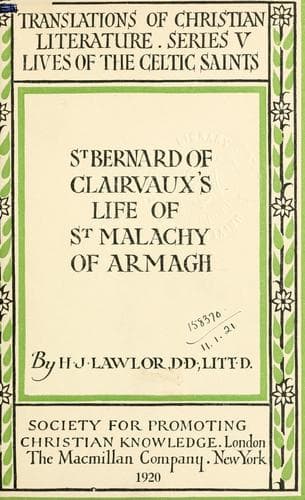
St. Bernard of Clairvaux's Life of St. Malachy of ArmaghBernard, of Clairvaux, Saint
History
St. Bernard of Clairvaux's Life of St. Malachy of Armagh
Bernard, of Clairvaux, Saint
Malachy, Saint, 1094?-1148
Anselm followed in the footsteps of Lanfranc. Not long after his
consecration (1093) he wrote to Donnell, Donough O'Hanley and the rest
of the bishops of Ireland, begging the aid of their prayers, and urging
them to consult him in all cases of difficulty. Almost immediately
afterwards came the election of Malchus, bishop of Waterford, in 1096.
Among those who signed the petition for his consecration were Bishop
Donnell, Samuel O'Hanley, whom Anselm had consecrated for Dublin earlier
in the same year, and O'Dunan, bishop of Meath (_Idunan episcopus
Midiae_), whose name we shall do well to remember. But most notable of
all were Murtough O'Brien, son of Turlough, then the strongest of Irish
kings, soon to be _ardrí_, and his brother Dermot O'Brien.[27] It is
clear that Lanfranc had won the O'Briens to the Romanizing side; and
Anselm was determined to hold them fast. Within the next few years there
was a fairly regular correspondence between him and Murtough, of which
some letters have been preserved.[28] The relation between the two men
was evidently most friendly. And the archbishop fully exploited his
opportunity. Again and again he reminded the king of his duty to repress
abuses, the most important of which in his eyes were lax sexual
morality, and the consecration of bishops by single bishops, without
fixed sees or defined dioceses.
So Lanfranc and Anselm schooled the O'Briens in the principles of Rome.
And from one point of view their efforts were completely successful. The
O'Briens became staunch friends of the Reform movement in Ireland. But
from another point of view they failed. We must remember that their aim
was not only to purify the Irish Church, but to bring it into subjection
to Canterbury. That they did not succeed in doing. The Reformation,
which they taught the O'Briens to support, meant, in the end, a
repudiation of the pretensions of the English primates.
Public-domain text, read in full here on John Shaqi.
Reviews
Reviews
No reviews yet
Be the first to share your thoughts on this work.
Join the Discussion
Join the discussion
Sign in to leave a comment or review.
Sign InorCreate an account