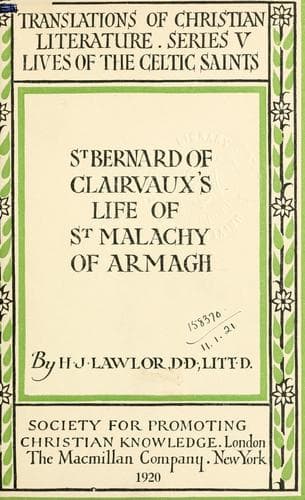
St. Bernard of Clairvaux's Life of St. Malachy of ArmaghBernard, of Clairvaux, Saint
History
St. Bernard of Clairvaux's Life of St. Malachy of Armagh
Bernard, of Clairvaux, Saint
Malachy, Saint, 1094?-1148
[1088] Ps. cxvi. 7, 8 (vg.).--The printed text has, in place of the
bracketed words, "and so forth." The threefold deliverance obviously
corresponds to the threefold rejoicing mentioned below, sin being
substituted for death in the description of it, because "the death of
the soul is sin."
[1089] Luke xxiv. 29.
[1090] Cp. Ps. cxvi. 8.
[1091] Ezek. xviii. 4.
[1092] Rom. vii. 17, 20.
[1093] Ps. cxvi. 8.
[1094] For other comparisons of Malachy with Elijah, see _Life_, § 23;
Serm. ii. § 8.
[1095] 2 Kings ii. 13.
[1096] Gen. xxxix. 12, 15 (vg.).
[1097] 2 Kings ii. 11.
[1098] Cant. i. 3, 4.
[1099] It is plain from § 7 that this sermon was preached on an
anniversary of Malachy's death, _i.e._ on November 2, in a year later
than 1148. I put it in 1149 because of its striking coincidences with
the _Life_, which was written early in that year (see p. lxv). There
is also a possible echo (§ 3) of _De Cons._ i. which belongs to the
same year (_P.L._ clxxxii. 723). These, together with two coincidences
of phrase with other writings of St. Bernard, are pointed out in the
notes. See _R.I.A._ xxxv. 260 ff.
[1100] 2 Cor. v. 6.
[1101] Rom. xii. 15.
[1102] Ps. lxviii. 3.
[1103] Ecclus. xliv. 7.
[1104] Ecclus. xliv. 16 (vg.).
[1105] Ecclus. xliv. 17.
[1106] Luke i. 75.
[1107] 1 Cor. ix. 18.--Cp. _Life_, § 43 (p. 84).
[1108] Eph. vi. 17.
[1109] Matt. xi. 30.
[1110] Ps. xvi. 5 (vg.).
[1111] Isa. xlviii. 20; Jer. xxv. 31.
[1112] Ps. ii. 8.
[1113] 2 Pet. ii. 1.
[1114] 1 Cor. vi. 20.
[1115] Acts xx. 28.
[1116] 2 Cor. xi. 7.
[1117] _Gratum erat munus gratuitum._
[1118] Matt. vi. 22; Luke xi. 34.
[1119] Hab. iii. 13.
[1120] Matt. vi. 22, 23; Luke xi. 34, 35.
[1121] Ps. cxi. 2 (vg.).
[1122] Gen. i. 31.
[1123] Ps. lxviii. 5.
[1124] 2 Cor. ix. 7.
[1125] 1 Cor. ix. 22.
[1126] Jas. iv. 6; 1 Pet. v. 5.
[1127] See _Life_, § 60.
[1128] 1 John iv. 6.
[1129] Printed text, _Ipse enim est._ With A I omit _enim_.
[1130] Josh. vii. 15, etc.
[1131] So A: _cicius_ (= _citius_) _ibat_ for _riuus ibat_ of the
printed text.
[1132] The story is told much more fully in _Life_, §§ 58, 59; where
there are many similarities in phraseology to the present passage. In
both places it is connected with the miraculous blinding of the king,
immediately preceding it here, immediately following it there.
[1133] Ps. lxxxvi. 5 (vg.).
[1134] Cp. the description of Malchus, _Life_, § 8: "He was reverenced
by all, as the one father of all"; and of Malachy, § 33: "the loving
father of all."
[1135] Matt. xxiii. 37.
[1136] Ps. lxi. 4 (vg.).
[1137] Cp. _Life_, § 42: "Neither sex nor age, nor condition nor
profession, is held in account."
[1138] Ps. xxxv. 10
[1139] Ps. iv. 4 (vg.).
[1140] Prov. xvi. 32.
[1141] Job xxxvi. 18 (vg.).
[1142] _Non urebatur illa, sed utebatur._
[1143] _Utriusque hominis sui._
[1144] 1 Tim. v. 22.
Public-domain text, read in full here on John Shaqi.
Reviews
Reviews
No reviews yet
Be the first to share your thoughts on this work.
Elsewhere in the archive
Join the Discussion
Join the discussion
Sign in to leave a comment or review.
Sign InorCreate an account