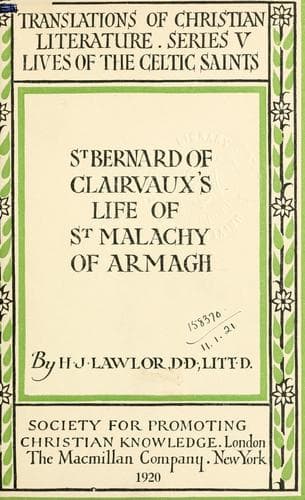
St. Bernard of Clairvaux's Life of St. Malachy of ArmaghBernard, of Clairvaux, Saint
History
St. Bernard of Clairvaux's Life of St. Malachy of Armagh
Bernard, of Clairvaux, Saint
Malachy, Saint, 1094?-1148
[1145] Cp. _De Cons._ i. 6: "If you desire wholly to belong to all ...
I praise your humility, but only if it is complete. But how can it be
complete if you exclude yourself? And you are a man. Then, that your
humanity also may be complete, let the bosom which receives all gather
you also within itself ... wherefore, where all possess you let you
yourself also be one of those who possess."
[1146] Lucan, _Phars._ ii. 383.
[1147] Cp. _De Cons._ iv. 12, "In ease not taking ease;" _Life_, § 43,
"Quiet often, but by no means at any time taking ease."
[1148] Ps. cxix. 23.
[1149] Eccles. ii. 14 (inexact quotation).
[1150] Cp. Luke iv. 22.
[1151] _Tantillus._ The text seems to be corrupt. Read _tam laetus?_
[1152] Cp. _Life_, § 43: "Yea, what was there that was not edifying,"
etc.
[1153] Ps. xx. 3 (vg.).
[1154] 2 Cor. ii. 15.
[1155] 1 Thess. i. 4 (vg.); 2 Thess. ii. 13.
[1156] That is, Malachias, the Hebrew for _my angel_, with a Latin
termination. For its origin see _Life_, § 12.
[1157] At this point, with A, I omit a passage which is identical with
the first half of Serm. i. § 5, and interrupts the argument. With A,
also, in the following sentence I read _Laetemur et nos dilectissimi
quod_ for _Laetemur quod_ of the printed text. See _R.I.A._ xxxv.
260-262.
[1158] Judg. xiii. 20.
[1159] Dan. vi. 13; Ezra iv. 1.
[1160] Ps. ix. 2.
[1161] _Curia._
[1162] _Cui sit cura nostri._
[1163] Cp. Lett. iv. § 2.
[1164] _Informauit._
[1165] _Confirmauit._
[1166] Song of Three Children, 16.
[1167] Ps. xliii. 4.
[1168] Jer. ix. 1.
[1169] Ps. xlv. 15.
[1170] Luke i. 68.
[1171] Matt. iv. 5.
[1172] Ps. cxxvi. 1, 4 (vg.).
[1173] Luke i. 47.
[1174] 1 Cor. vi. 17.
[1175] See _De Cons._ v. 2, quoted p. 127, n. 13, and the sermon on
the Marriage of the Soul with the Word (_Cant._ lxxxiii. 6), in which
St. Bernard, quoting 1 Cor. vi. 17, says, "Love ... joins the two in
one spirit, makes them no longer two but one." Cp. also _Cant._ xxvi.
5: "He that is joined to God is one spirit, and is wholly changed into
a certain divine feeling, and cannot think of or mind anything but
God, and that which God thinks and minds, being full of God." For the
last phrase see Ignatius, _Magn._ 14.
[1176] Ps. xciii. 5.
[1177] Ps. xxx. 4.
[1178] Luke i. 75.
[1179] Ps. cxlv. 7 (vg.).
[1180] 1 Sam. xv. 17 (inexact quotation).
[1181] Luke i. 49.
[1182] Ps. cxlv. 5 (vg.).
[1183] Num. xi. 25; 2 Kings ii. 9, 15.
[1184] Luke i. 17.--See p. 151, n. 3.
[1185] Ecclus. xlv. 5.
[1186] The same phrase occurs in _Life_, § 75, similarly applied.
[1187] Isa. lxii. 3.
[1188] Ps. lii. 8 (vg.).
[1189] Ps. xlv. 7 (vg.).
[1190] Epiphany Collect.
[1191] Cp. _Life_, § 47 (p. 88).
[1192] Isa. xxvii. 6, combined with Hos. xiv. 5, and Ecclus. xxxix.
14.
[1193] Ecclus. xlv. 1.
[1194] Ecclus. xxiv. 2, 12 (vg.). The clauses containing the word
assembly (_plenitudo_) are omitted in R.V.
[1195] Ps. cxxxvi. 7.
[1196] John i. 4.
[1197] Ps. xlvi. 4.
[1198] Ecclus. l. 6.
Public-domain text, read in full here on John Shaqi.
Reviews
Reviews
No reviews yet
Be the first to share your thoughts on this work.
Elsewhere in the archive
Join the Discussion
Join the discussion
Sign in to leave a comment or review.
Sign InorCreate an account