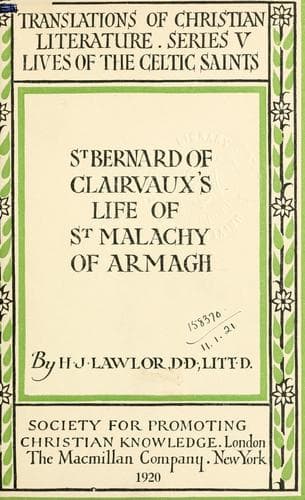
St. Bernard of Clairvaux's Life of St. Malachy of ArmaghBernard, of Clairvaux, Saint
History
St. Bernard of Clairvaux's Life of St. Malachy of Armagh
Bernard, of Clairvaux, Saint
Malachy, Saint, 1094?-1148
3. The sacrament of Confirmation was not celebrated, at any rate in
Armagh (§ 7). This rite has always been used in the Irish Church, though
possibly neglected locally at some periods. St. Patrick tells us that he
"confirmed in Christ" those whom he had "begotten to God" (_Epistle_, 2;
cp. _Confession_, 38, 51)--thus giving us one of the earliest instances
in literature of the application to the rite of its present familiar
name. But in his practice (_Epistle_, § 3), as in the Stowe Missal,
about A.D. 800 (ed. Sir G. F. Warner, vol. ii. p. 31), it seems to have
consisted of an anointing with chrism without laying on, or raising, of
hand, or a direct prayer for the Holy Spirit. According to the Stowe
Missal it was administered by a presbyter. It is improbable that St.
Bernard or his romanizing friends would recognize the rite so performed
as true Confirmation.
4. One of the things which was neglected at Armagh was "the marriage
contract" (§ 7). In the diocese of Connor there was "no entry into
lawful marriages" (§ 16). By the labours of Malachy this abuse
disappeared. In Armagh he "instituted anew" the marriage contract; in
Connor it came to pass that "the celebration of marriage" was revived (§
17). Putting these statements together we may conclude that St.
Bernard's meaning is that marriages had ceased to be celebrated in the
face of the Church, and that in consequence the vow of a life-long union
was often evaded. Now contemporary writers charge the Irish of this
period with loose sexual morality, especially in regard of arbitrary
divorce, matrimony within the prohibited degrees, exchange of wives, and
other breaches of the law of marriage. Such accusations are made, for
example, by Pope Gregory VII. (Haddan and Stubbs, _Eccl. Docs._ ii.
160), Lanfranc (Ussher, 490; _P.L._ cl. 535, 536), Anselm (Ussher 521,
523; _P.L._ clix. 173, 178) and Giraldus Cambrensis (_Gest._ ii. 14;
_Top._ iii. 19). Their evidence is the more worthy of credence because
the usages to which they refer were characteristic of the Irish at an
earlier period (_Encycl. of Religion and Ethics_, v. 456, 460), and
might be expected to recur in an age of spiritual decline. But both
Lanfranc and Anselm testify to the existence of marriage as an
institution among the Irish. The former speaks of the divorce of a wife
"lawfully joined to her husband," and the latter uses terms of similar
import. So also does St. Bernard himself. His praise of Malachy's mother
(_Life_, § 1) is inconceivable if she did not live in wedlock; and he
expressly states that eight "metropolitans" of Armagh were "married men"
(§ 19). But if there was nevertheless a revival among large sections of
the people of pagan ideas of marriage, which tolerated polygamy,
concubinage, incest and easy termination of unions, it can be understood
that marriage in the face of the Church, which included a vow absolutely
prohibitive of all these things, would be commonly avoided. Malachy's
Public-domain text, read in full here on John Shaqi.
Reviews
Reviews
No reviews yet
Be the first to share your thoughts on this work.
Elsewhere in the archive
Join the Discussion
Join the discussion
Sign in to leave a comment or review.
Sign InorCreate an account