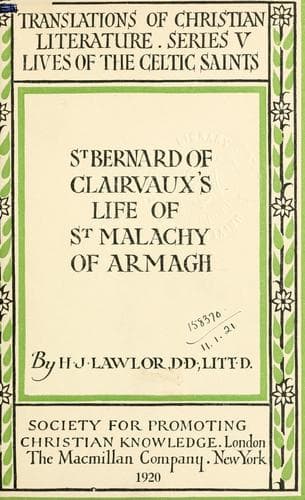
St. Bernard of Clairvaux's Life of St. Malachy of ArmaghBernard, of Clairvaux, Saint
History
St. Bernard of Clairvaux's Life of St. Malachy of Armagh
Bernard, of Clairvaux, Saint
Malachy, Saint, 1094?-1148
It is indeed wonderful that it should have done so. For the method of
the Synod--fixing the number of the dioceses before their boundaries
were discussed--was unstatesmanlike. Always, and necessarily,
ecclesiastical divisions have coincided with civil divisions. We may
find the germ of the rule in the Acts of the Apostles.[53] If this was
inevitable in other lands it was even more inevitable in Ireland in
pre-Norman days. The Irish people was a collection of clans, having, it
is true, certain common institutions, but bound together by no sort of
national constitution, and often at war with each other. If
ecclesiastical divisions were to be permanent in Ireland, they must take
account of the tribal divisions of the country. The primary
ecclesiastical unit must be the territory of a tribe, just as it was the
primary civil unit.[54] But to base the limits of dioceses, consistently
and in every case, on tribal boundaries was impossible when the number
of dioceses was arbitrarily fixed beforehand. It could not be that
exactly the same number of dioceses would suit Ulster as suited Leinster
and Connaught. In one province the tribes would be more or less
numerous, and more or less mutually antagonistic, than in another. By
reason of its method, therefore, the Synod was doomed to fall short of
complete success in its work.
We have instances in Ulster of the soundness of the principle that I
have stated. Take the diocese of Raphoe. It was designed to include
Inishowen. But from a tribal point of view Inishowen (Inis Eoghain)
belonged to the next diocese, which included the tribeland of Tír
Eoghain. Its inhabitants were of the same stock as the Cenél Eoghain,
and were known as the Cenél Eoghain of the Island. So the natural result
followed. Inishowen broke off from the diocese of Raphoe and became part
of the diocese of Derry. When this happened the diocese of Raphoe was
stabilized. It consisted of the land of a single tribe, the Cenél
Conaill; and so henceforth its limits were never altered.
We can easily understand, therefore, that the disregard of tribal
boundaries, forced on it in many cases by its method, was an element of
weakness in the Rathbreasail scheme. And yet it was natural that special
stress should be laid on the arbitrary limitation of sees which was its
main cause. Ireland was overrun with bishops. It is said that over fifty
of them attended the Synod of Rathbreasail; and they represented only
part of the country. But Gilbert had laid down the rule that an
archbishop could not have more than twenty suffragans. On this
principle, if all the existing bishops had been provided with dioceses,
or all the larger tribes had been given bishops, Ireland would have had
not two, but six or seven archbishops: and this would have been a
travesty of Catholic Church order, as it was then understood. It was
essential that the number should be ruthlessly cut down.
Public-domain text, read in full here on John Shaqi.
Reviews
Reviews
No reviews yet
Be the first to share your thoughts on this work.
Join the Discussion
Join the discussion
Sign in to leave a comment or review.
Sign InorCreate an account