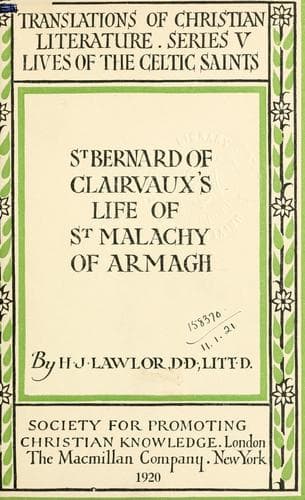
St. Bernard of Clairvaux's Life of St. Malachy of ArmaghBernard, of Clairvaux, Saint
History
St. Bernard of Clairvaux's Life of St. Malachy of Armagh
Bernard, of Clairvaux, Saint
Malachy, Saint, 1094?-1148
obedient suffragans of Canterbury; and we cease to wonder that they were
ignored in the Rathbreasail decrees.
Another feature of the canons of the Synod is worth noting. In several
instances the see of a diocese was not absolutely fixed. Two places were
named, and it was apparently left to the bishop of the future to select
that one of the two which he preferred to be his city. Thus we have a
diocese of Derry or Raphoe, a diocese of Connor or Down, another of
Wexford or Ferns, and so forth. The meaning of this is best seen by
taking a single example. To one of the dioceses of Munster was assigned
the area now occupied by the two dioceses of Waterford and Lismore. It
consisted of the original Danish diocese of Waterford, together with a
much more extensive non-Danish area. Alternative sees were named; it was
described as the parish of Lismore or Waterford. Now Lismore was the
most sacred spot in the enlarged diocese. It was the site of a monastery
founded by St. Mochuta. It was an ideal place for a bishop's see. But it
was doubtless ruled at the moment by an abbot, the coarb of Mochuta.
Unless he was prevailed on to accept episcopal orders, or was deprived
of his authority, a diocesan bishop could not be established there. On
the other hand, Waterford had no sacred traditions; but it was already
the see of a diocese. In default of Lismore it would be a convenient
place for the see. Between Lismore and Waterford the circumstances of
the future must decide. Ultimately, it appears, Malchus retired from the
archbishopric of Cashel, and became bishop of his older diocese, now so
much greater than it had been. He placed his stool, however, not at
Waterford but at Lismore.[62] A similar, but not always identical
course was followed in other such cases.
What the Synod of Rathbreasail actually accomplished was this. It gave
to Ireland a paper constitution of the approved Roman and Catholic type.
But by doing this it had not achieved the purpose of its existence. In
the years that followed, its enactments had to be carried into effect.
And here was the real crux. Before the Church came to be ruled by
diocesan bishops, the existing rulers--the coarbs of church
founders--must be dispossessed of their authority; the numerous bishops
of the old Irish type must be got rid of; the jurisdiction of the new
bishops must be fixed by common consent, or enforced without it; and
revenues must be provided for them. A mere synodal decree could not
accomplish all this. The diocesan system could become a fact throughout
the whole Church, and the last vestiges of the ancient constitution be
made to disappear, only after determined effort, and probably bitter
contention. And when all was done it would certainly be found that the
scheme of dioceses arranged at Rathbreasail had been largely departed
from.
Public-domain text, read in full here on John Shaqi.
Reviews
Reviews
No reviews yet
Be the first to share your thoughts on this work.
Join the Discussion
Join the discussion
Sign in to leave a comment or review.
Sign InorCreate an account