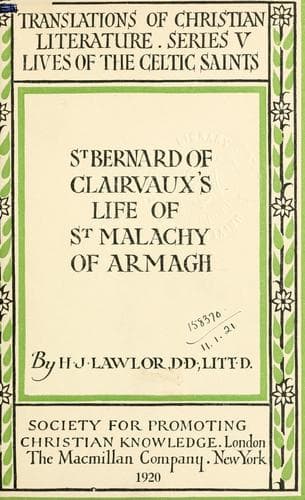
St. Bernard of Clairvaux's Life of St. Malachy of Armagh — John Shaqi
St. Bernard of Clairvaux's Life of St. Malachy of ArmaghBernard, of Clairvaux, Saint
History
St. Bernard of Clairvaux's Life of St. Malachy of Armagh
Bernard, of Clairvaux, Saint
Malachy, Saint, 1094?-1148
Clonmacnoise preserved its independence three centuries longer. It was
incorporated with Meath in 1569. Thus at length the dream of the fathers
of Rathbreasail was fulfilled. There were two dioceses in the ancient
kingdom of Meath--Meath and Kilmore. But neither Duleek nor Clonard nor
Clonmacnoise was a see. From that day to this, in fact, the diocese of
Meath has had no see. And the boundary which parts Meath from Kilmore is
very different from the line which the fathers of Rathbreasail drew
between the dioceses of Clonard and Duleek, or that which the assembly
of Usnagh drew between Clonmacnoise and Clonard.
IV.--St. Malachy's Part in The Reformation
It is not possible, within the limits of this Introduction, to follow
the later stages of the Reformation movement in detail. In the present
section I confine myself to the part which St. Malachy played in its
development.
Malachy was born at Armagh in 1095. He was therefore a mere boy when the
Synod of Rathbreasail met. At the dawn of his manhood he became the
disciple of the recluse Imar O'Hagan. Imar was in sympathy with the aims
of the reformers, and it was probably through his influence that Malachy
became imbued with their principles. He soon attracted the notice of
Cellach, and was by him ordained deacon. He was advanced to the
priesthood about 1119. Shortly afterwards Cellach made the young priest
his vicar. For the next year or two it was Malachy's duty to administer
the diocese of Armagh; and he did so in the most effective--indeed
revolutionary--fashion. He evidently let no man despise his youth. His
purpose, as his biographer tells us, was "to root out barbarous rites,
to plant the rites of the Church." "He established in all the churches
the apostolic sanctions and the decrees of the holy fathers, and
especially the customs of the Holy Roman Church." He introduced the
Roman method of chanting the services of the canonical hours. "He
instituted anew Confession, Confirmation, the Marriage contract, of all
of which those over whom he was placed were either ignorant or
negligent." In a word, Malachy showed himself an ardent reformer.[71]
Public-domain text, read in full here on John Shaqi.
Reviews
Reviews
No reviews yet
Be the first to share your thoughts on this work.
Join the Discussion
Join the discussion
Sign in to leave a comment or review.
Sign InorCreate an account