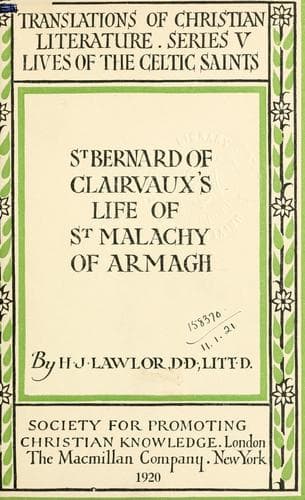
St. Bernard of Clairvaux's Life of St. Malachy of ArmaghBernard, of Clairvaux, Saint
History
St. Bernard of Clairvaux's Life of St. Malachy of Armagh
Bernard, of Clairvaux, Saint
Malachy, Saint, 1094?-1148
The opportunity had come for
gratifying its desire, and at the same time bringing it under the Irish
ecclesiastical régime. The pall at once separated it from Canterbury and
united it with Ireland. It was the price paid for its submission to the
Primacy of Armagh. Gregory therefore became archbishop of Dublin, and
had the right--which his predecessor had long before illegally
assumed--to have the cross carried before him. With the gift of the pall
Paparo bestowed upon him "the principal part of the bishopric of
Glendalough as his diocese," promising him the remainder on the death of
the bishop who then ruled it. All this was done, we are told, because it
was fitting that the place "in which from ancient time had been the
royal seat and head of Ireland," should be made a metropolitan see.[93]
There was at last one Church in Ireland, which embraced within it not
only the Celtic parts of the island, but all the Danish dioceses as
well. And the whole Church was ruled by the bishops. The Reformation may
not have been complete in every detail--there was indeed much left for
the Anglo-Normans to do--but the Synod of Kells had set the crown on the
work of the Irish reformers. And this consummation was mainly due to the
wisdom and the untiring zeal of St. Malachy of Armagh.
* * * * *
A few words more will suffice to complete this too lengthy
introduction. The _Life of Malachy_ was certainly written before the
Synod of Kells met in March 1152; for Christian, who attended the Synod
as bishop of Lismore, is spoken of in the _Life_ as abbot of
Mellifont.[94] Its earliest possible date is a couple of months after
Malachy's death. The ignorance displayed in § 69[95] of the movements of
the Pope in 1148 is so inexplicable on the assumption of a later date
that it may be assigned to January 1149.[96] In the following
translation the text printed by de Backer[97] is used, with the
exception of a few sentences which have been emended. It does not differ
to any great extent from that of Mabillon.[98] Following de Backer I
have divided the text into chapters, in accordance with the MSS.; but
Mabillon's sections have been retained, as more convenient for
reference, the numbers of de Backer's sections being added within
brackets.
By way of illustration four letters of St. Bernard and his two sermons
on St. Malachy have been added. They are translated from Mabillon's
edition,[99] with some corrections. The dates of these documents are
discussed below.[100]
St. Bernard's numerous quotations from the Bible and other sources are
printed in italics, so far as I have recognized them. The scriptural
allusions are given as nearly as possible in the words of the Authorized
(in the Apocryphal books the Revised) Version, though at times they do
not agree with the Vulgate Latin. Where it has been found necessary to
depart from their renderings, the symbol "vg." follows the references in
the footnotes.
Public-domain text, read in full here on John Shaqi.
Reviews
Reviews
No reviews yet
Be the first to share your thoughts on this work.
Join the Discussion
Join the discussion
Sign in to leave a comment or review.
Sign InorCreate an account