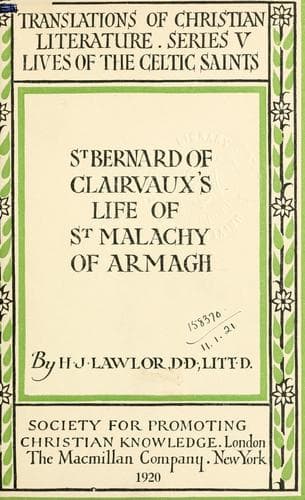
St. Bernard of Clairvaux's Life of St. Malachy of ArmaghBernard, of Clairvaux, Saint
History
St. Bernard of Clairvaux's Life of St. Malachy of Armagh
Bernard, of Clairvaux, Saint
Malachy, Saint, 1094?-1148
[25] Ussher, 567; _Beati Lanfranci Opera_, ed. J. A. Giles, Oxon.,
1844, vol. i. p. 24.
[26] See Ussher, 490-497; _P.L._ cl. 532, 535, 536. This Donnell was
probably Donnell O'Heney (Ua hEnna), a Munster bishop who died in 1098
(_A. U._).
[27] Ussher, 515-519. The letter to Donnell is also in _P.L._ clix.
262.
[28] Ussher, 520-527; _P.L._ clix. 173, 178, 243.
[29] _Miscellany of Irish Archælogical Society_, vol. i. (1846), p.
136.
[30] Wilkins, _Concilia_, i. 547. In the form in which Rochfort quotes
it the ordinance applies to the whole of Ireland. But we have no
evidence of the transformation of dioceses into deaneries outside
Meath; and it is quite probable that a synod held in Meath would have
in view, in such a decree, only the conditions which prevailed in that
district.
[31] The deanery of Dunshaughlin is now named Ratoath. The deanery of
Kells has been divided into Upper and Lower Kells.
[32] The cogency of this argument is enhanced when we observe that
there is strong independent evidence for the existence in the twelfth
century of one of the six dioceses--the diocese of Kells. (_a_) Up to
the latter part of the sixteenth century (1583) there was an
archdeacon of Kells, as well as an archdeacon of Meath; the
jurisdiction of an archdeacon (at any rate in Ireland) seems to have
been always originally co-extensive with a diocese. The first known
archdeacon of Kells was Adam Petit who was in office in 1230 (_R.T.A._
279; _C.M.A._ i. 101); but it is unlikely that he had no predecessors.
(_b_) Among the prelates who greeted Henry II. at Dublin in 1171 was
Thaddaeus, bishop of Kells (Benedict of Peterborough (R. S.), i. 26).
(_c_) In the time of Innocent III. (1198-1216) the question was raised
in the papal curia whether the bishop of Kells was subject to the
archbishop of Armagh or the archbishop of Tuam (Theiner, p. 2). (_d_)
The bishop of Kells is mentioned in a document of the year 1202 (_Cal.
of Docts. Ireland_, i. 168). (_e_) A contemporary note records the
suppression of the bishopric: "When a Cistercian monk ... had been
elected and consecrated bishop of Kells by the common consent of the
clergy and people, and had been confirmed by the Pope, the impudent
bishop of Meath cast him out with violence and dared to [add] his
bishopric to his own" (_C.M.A._ ii. 22). This statement implies that
the dispossessed bishop ruled over a diocese. Moreover, when we
remember that the see was certainly suppressed before Rochfort's Synod
of 1216, that Rochfort was the first person who assumed the title
"bishop of Meath" in the modern sense, and that a bishop of Kells died
in 1211 (_A.L.C._), we need not hesitate to conclude that the
"impudent bishop" was Rochfort himself, and that the suppression was
accomplished about 1213.
Public-domain text, read in full here on John Shaqi.
Reviews
Reviews
No reviews yet
Be the first to share your thoughts on this work.
Join the Discussion
Join the discussion
Sign in to leave a comment or review.
Sign InorCreate an account