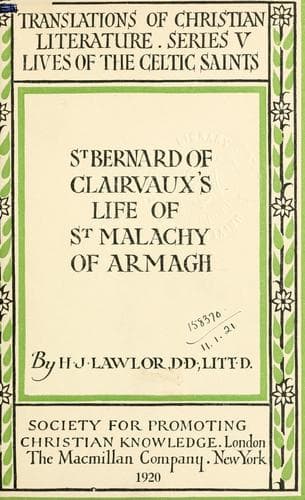
St. Bernard of Clairvaux's Life of St. Malachy of ArmaghBernard, of Clairvaux, Saint
History
St. Bernard of Clairvaux's Life of St. Malachy of Armagh
Bernard, of Clairvaux, Saint
Malachy, Saint, 1094?-1148
First, I must emphasize the assertion made a moment ago that the
constitution of the Irish Church in the eleventh century was _sui
generis_. Let us begin by reminding ourselves what it was from the sixth
to the eighth century. It was then essentially monastic in character.
The rulers of the Church were the abbots of the monasteries, commonly
known as the coarbs or successors of their founders. These abbots were
sometimes bishops; but whether they were bishops or of lower rank in the
ministry, their authority was inherent in their office of coarb. At this
period bishops were numerous--more numerous than in later medieval or
modern times; and certain functions were reserved for bishops, for
example, ordination. No ecclesiastic, of whatever status, could perform
such functions, unless he was of the episcopal order. But no bishop, as
such, had jurisdiction. The bishops were often subordinate officers in
monasteries, reverenced because of their office, but executing their
special functions at the command of the abbots. Sometimes a bishop was
attached to a single tribe. Sometimes a group of bishops--often seven in
number--dwelt together in one place. But in no case, I repeat, had they
jurisdiction. Thus ecclesiastical authority was vested in the abbots.
The episcopate was bestowed on certain individuals as a personal
distinction. Thus the bishops, if they were not also abbots, had only
such influence on the affairs of the Church as their sanctity, or their
learning, might give them.
It may surprise some that so anomalous a system of government should
have persisted as late as the eleventh century, in other words for a
period of over 500 years. But we must take account of the Danish--or as
we should rather call it, the Norse--invasion of Ireland. Danish ships
first appeared off the Irish coasts about the year 800. From that time
for two centuries Ireland was to a large extent cut off from intercourse
with the rest of Europe. The aim of the northern hordes, as it seems,
was not mere pillage, but the extinction of Christianity. Ecclesiastical
institutions were everywhere attacked, and often destroyed. And these
institutions were centres of scholarship. Heretofore Ireland had been
the special home of learning, and had attracted to itself large numbers
of foreign students. But in those disastrous centuries its culture was
reduced to the lowest point. In such circumstances it was not possible
that the organization of the Church should be developed or strengthened.
The Danish domination of the country must have tended to stereotype the
old hierarchical system. It might, indeed, suffer from deterioration: it
probably did. But it could not be assimilated to the system which then
prevailed on the Continent. We should expect that the constitution of
the Church in the eleventh century, whatever abuses may have crept into
its administration, would in principle be identical with that of the
pre-Danish period.
Public-domain text, read in full here on John Shaqi.
Reviews
Reviews
No reviews yet
Be the first to share your thoughts on this work.
Join the Discussion
Join the discussion
Sign in to leave a comment or review.
Sign InorCreate an account