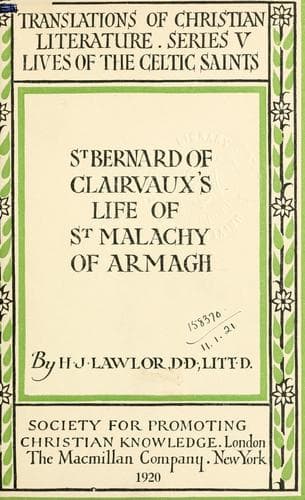
St. Bernard of Clairvaux's Life of St. Malachy of ArmaghBernard, of Clairvaux, Saint
History
St. Bernard of Clairvaux's Life of St. Malachy of Armagh
Bernard, of Clairvaux, Saint
Malachy, Saint, 1094?-1148
31. (19). So then Malachy, when within three years[490] _a reward was
rendered to the proud_[491] and liberty restored to the church,
barbarism driven out and the customs of the Christian religion
everywhere instituted anew, seeing that all things were at peace, began
to think also of his own peace. And mindful of his design he appointed
in his own place Gelasius,[492] a good man, and worthy of so great an
honour, the clergy and people tacitly assenting, or rather supporting
him because of the agreement.[493] For apart from that it seemed
altogether cruel. And when he had been consecrated and earnestly
commended to the kings and princes, Malachy himself, renowned for
miracles and triumphs, returned to his parish;[494] but not to Connor.
Hear the cause, which is worth relating. It is said that that diocese in
ancient times had two episcopal sees, and that there were two
bishoprics; an arrangement which seemed to Malachy preferable to the
existing one. Hence those bishoprics which ambition had welded into
one,[495] Malachy divided again into two, yielding one part to another
bishop and retaining the other for himself. And for this reason he did
not come to Connor, because he had already ordained a bishop in it;[496]
but he betook himself to Down, separating the parishes _as in the days
of old_.[497] O pure heart! O dove-like eye![498] He handed over to the
new bishop the place which seemed better organized, which was held to be
more important, the place in which he himself had sat. Where are they
that fight about boundaries, carrying on perpetual hostilities against
one another for a single village? I know not if there is any class of
men whom that ancient prophecy touches more than those: _They have
ripped up the women with child of Gilead that they might enlarge their
border._[499] But this at another place.[500]
32. When Malachy was made bishop of Down, immediately according to his
custom he was at pains to take to himself from his sons, for his
comfort, a convent of regular clerics.[501] And lo, again he girds
himself, as though a new recruit of Christ, for the spiritual conflict;
again he puts on the _weapons_ that are _mighty through God_,[502] the
humility of holy poverty, the rigour of monastic discipline, the
quietness of contemplation, continuance in prayer. But all these things
for a long time he was able to maintain rather in will than in deed. For
all men came to him; not only obscure persons, but also nobles and
magnates, hastened to commit themselves to his wisdom and holiness for
instruction and correction. And he himself meanwhile went about; _he
went out to sow his seed_,[503] disposing and decreeing with all
authority concerning ecclesiastical affairs, like one of the Apostles.
And none _said unto him, By what authority doest thou these
things_?[504] inasmuch as all _saw the miracles_ and wonders _which_ he
did,[505] and because _where the Spirit of the Lord is, there is
liberty_.[506]
FOOTNOTES:
Public-domain text, read in full here on John Shaqi.
Reviews
Reviews
No reviews yet
Be the first to share your thoughts on this work.
Elsewhere in the archive
Join the Discussion
Join the discussion
Sign in to leave a comment or review.
Sign InorCreate an account