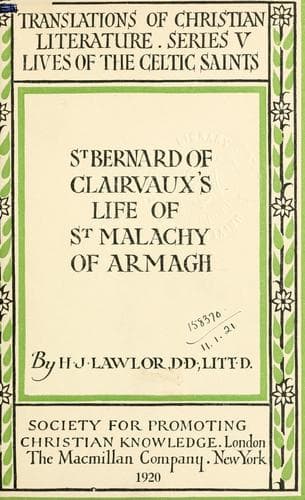
St. Bernard of Clairvaux's Life of St. Malachy of ArmaghBernard, of Clairvaux, Saint
History
St. Bernard of Clairvaux's Life of St. Malachy of Armagh
Bernard, of Clairvaux, Saint
Malachy, Saint, 1094?-1148
[365] That is, while Malachy was in Iveragh.
[366] Cellach is here mentioned by name for the first time. See p. 14,
n. 2.
[367] Harris (_Ware's Works_, ii., "Writers," p. 69) identifies this
testament with the _Testamentum ad ecclesias_, a tract attributed to
Cellach, which is apparently no longer extant. But it may be doubted
whether the testament mentioned in the text was committed to writing.
[368] The designation by a coarb of his successor seems to have been
unusual. But in 1124 Malachy had in this way been appointed abbot of
Bangor (§ 12); and in 1134 Murtough designated Niall as his successor
in the abbacy of Armagh (§ 22).
[369] Conor O'Brien, king of Thomond, and Cormac Mac Carthy, king of
Desmond. See § 9, and p. 21, notes 1-3. Murtough O'Brien, king of
Munster, fell into ill-health in 1114, and his brother Dermot
attempted, evidently with some success, to seize the throne. Dermot
died in 1118 and Murtough early in the following year. Turlough
O'Conor, the powerful king of Connaught, promptly invaded Munster, and
divided it into two vassal kingdoms, Thomond and Desmond. The former
he gave to the sons of Dermot, of whom Conor was one, the latter to
Teague Mac Carthy. Apparently Conor O'Brien soon established himself
as sole king of Thomond, and Cormac Mac Carthy became king of Desmond
on the death of his father, Teague, in 1124. We have seen that both of
them were deposed in 1127, and quickly restored (§ 9 f.: see p. 21, n.
3; p. 23, n. 2). From that time Conor and Cormac were allies. Cormac
married Conor's niece (_A.T._ 1138). Together in 1133 they invaded
Connaught (_A.F.M._), and the next year they made another successful
expedition through Connaught into Ulster (then ruled by Conor
O'Loughlin; see p. 40, n. 2), in the course of which they burned the
church of Rathluraigh, now Maghera, co. Derry, near the border of the
diocese of Armagh (_D.A.I._). This expedition must be referred to
hereafter (p. 51, n. 2). But Conor evidently aspired to be _ardrí_ of
Ireland, and he found it desirable to remove a possible rival.
Accordingly Cormac was murdered by his father-in-law, Conor's brother,
in 1138, and Conor became king of all Munster. He was now the most
powerful prince in Ireland; but he died, after a lingering illness
(Tundale, p. 42), in 1142, without attaining his ambition.
Public-domain text, read in full here on John Shaqi.
Reviews
Reviews
No reviews yet
Be the first to share your thoughts on this work.
Elsewhere in the archive
Join the Discussion
Join the discussion
Sign in to leave a comment or review.
Sign InorCreate an account