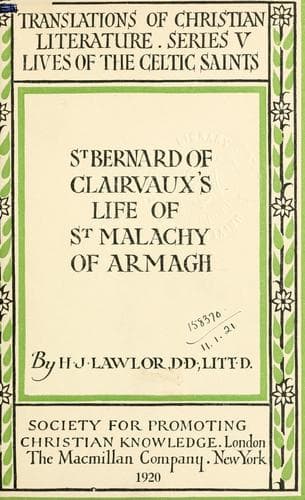
St. Bernard of Clairvaux's Life of St. Malachy of ArmaghBernard, of Clairvaux, Saint
History
St. Bernard of Clairvaux's Life of St. Malachy of Armagh
Bernard, of Clairvaux, Saint
Malachy, Saint, 1094?-1148
[436] The staff of Jesus was a wooden crozier (Giraldus, _Top._ iii.
34), richly adorned. The story of its presentation by Christ to St.
Patrick is found in the tenth-century _Trip._ (p. 30), no doubt taken
from an earlier source. The staff was much older than the _Book of
Armagh_; for we find that it was "profaned" in 789, and it was then
apparently regarded as the principal relic of St. Patrick (_A.U._
788). It seems that there was a still more ancient tradition, that St.
Patrick gave it to St. Mac Cairthinn (_R.I.A._ xxxiv. 114), from which
it may be inferred that it once belonged to the church of Clogher. It
was removed from Armagh to Dublin in 1180, and deposited in Christ
Church. It was burnt in 1538 (_A.L.C._). Apparently St. Bernard is the
only authority for the statement that it was "fashioned" by Christ. It
appears that the staff of Jesus, in the twelfth century, was regarded
as a much more important relic than the _Book of Armagh_, and was more
closely associated with the person and office of the coarb of Patrick.
It is frequently mentioned in such a way as to suggest that it was one
of the insignia of his authority (_A.U._ 1015, 1073, 1101, 1113, 1157,
1166, 1167; _A.F.M._ 1135, 1139, 1143, 1148, 1152). Similar references
to the _Book of Armagh_ do not occur till near the close of the
twelfth century, immediately after the removal of the staff from
Armagh (_A.U._ 1179, 1196; Gwynn, p. civ.). A very full account of the
later history of the staff may be read in _O.C.C._ pp. viii-xx.
[437] Deut. xxxii. 6.
[438] _Gyrovagus._ The word is commonly used of a monk who leaves his
proper monastery, and wanders about from one cell to another (see,
_e.g._, St. Bernard, _Ep._ 68, § 4), or to a priest who deserts his
parish (Du Cange, _s.v._).
[439] Job i. 6, 7; ii. 2.
[440] King (_Primacy of Armagh_, p. 97) thought that this was Conor
O'Loughlin. But he could hardly be described as "of the unrighteous
race," or as a "prince," which would indicate a petty chieftain.
Probably the conspirator was a local magnate.
[441] Matt. xxvi. 4, combined with Luke xxii. 2.
[442] Cp. Acts xxiii. 12 f.
[443] Matt. xxvi. 48.
[444] 1 Macc. i. 30.
[445] Cp. 1 Cor. xi. 1.
[446] Matt. x. 38, etc.
[447] Acts xxv. 11.
[448] 1 Pet. v. 3 (vg., inexact quotation).
[449] _Formam._ The word occurs in the verse just quoted, and in the
context of that which follows (Phil. ii. 7).
[450] Phil. ii. 8.
[451] Ps. lxxviii. 7.
[452] Acts xxi. 13; John xi. 16.
[453] Cp. Apuleius, _Metamorph._ xi. 23.
[454] Eph. vi. 16.
[455] Gen. iv. 6.
[456] Exod. xv. 16.
[457] Ps. xxvii. 2 (vg.).
[458] John iv. 37.
Public-domain text, read in full here on John Shaqi.
Reviews
Reviews
No reviews yet
Be the first to share your thoughts on this work.
Elsewhere in the archive
Join the Discussion
Join the discussion
Sign in to leave a comment or review.
Sign InorCreate an account