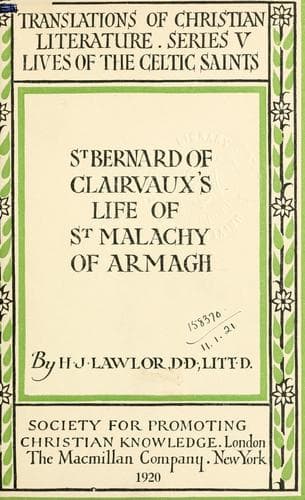
St. Bernard of Clairvaux's Life of St. Malachy of ArmaghBernard, of Clairvaux, Saint
History
St. Bernard of Clairvaux's Life of St. Malachy of Armagh
Bernard, of Clairvaux, Saint
Malachy, Saint, 1094?-1148
[459] While accepting the facts here narrated, so far as they were
capable of being observed, one cannot ignore the probability that they
were misinterpreted. It is quite possible that the offer of peace was
made in good faith, and that Malachy and his friends were unduly
suspicious when they "foresaw guile." The prince may have surrounded
himself with armed men as a mere matter of prudence.
[460] Susanna, 62.
[461] Luke xvi. 8.
[462] § 23.
[463] _Mulctatum in corpore._
[464] _Mutatum in corde._
[465] Ps. x. 2.
[466] Jer. xvii. 7, etc.
[467] _Plebes._
[468] That is, the church of Armagh.
[469] Hos. ii. 6.
[470] Rom. xii. 3; xv. 15, etc.
[471] This statement can hardly be regarded as accurate. Flann Ua
Sinaich, keeper of the staff of Jesus, having died, Malachy purchased
it on July 7, 1135; or, in other words, as we may suppose, bribed the
new keeper to hand it over to him (_A.F.M._). Niall himself may have
subsequently surrendered the _Book of Armagh_.
[472] 1 Tim. ii. 11.
[473] Rom. xv. 13 (vg.).--The success of Malachy in establishing peace
in the latter years of his rule at Armagh may be attributed in part to
the influence of a prince who is not mentioned in the text. Donough
O'Carroll first appears in the Annals as chieftain of the men of
Fearnmaigh (now represented by the barony of Farney, co. Monaghan),
whom he led in an expedition against Fingal (the district north of
Dublin) in 1133. He seems to have succeeded to the kingdom or lordship
of Oriel (which included the present counties of Armagh, Monaghan and
Louth) on the death of Conor O'Loughlin (May 1136); for in 1138, "with
the Oirgialla," he took part in an invasion of Meath. His career was
prosperous till 1152, when he assaulted the coarb of Patrick
(Gelasius). In consequence he was attacked by the Cenél Eoghain, and
expelled from Oriel. In 1155 he was imprisoned by Tighernan O'Rorke in
Lough Sheelan, for six weeks; but he escaped and recovered his
kingdom, and was present at the consecration of the Church of
Mellifont Abbey in 1157. He was murdered in 1168. For his support of
Malachy see Additional Note C, p. 170.
[474] This is obviously not the king mentioned in §§ 22, 24, 25. The
reference may be to Conor O'Loughlin, who was king of Oriel till he
was murdered in May 1136 (p. 40, note 2), or his successor, Donough
O'Carroll.
[475] Ecclus. xxi. 7.
[476] Gal. ii. 11.
[477] Exod. xvi. 20 (vg., inexact quotation).
[478] Acts vi. 10 (vg.).
[479] Isa. ii. 22; cf. Job xxvii. 3; Wisd. ii. 2.--The words might be
rendered "a spirit (_spiritus_) in her nostrils." The meaning is not
clear. In the biblical passages in which the phrase occurs it
indicates mortality. On the other hand, by the previous sentence St.
Bernard suggests that, in contrast to Malachy, the woman spoke under
the influence of an evil spirit.
[480] Mark xiv. 61.
[481] 2 Kings ii. 23.
Public-domain text, read in full here on John Shaqi.
Reviews
Reviews
No reviews yet
Be the first to share your thoughts on this work.
Elsewhere in the archive
Join the Discussion
Join the discussion
Sign in to leave a comment or review.
Sign InorCreate an account