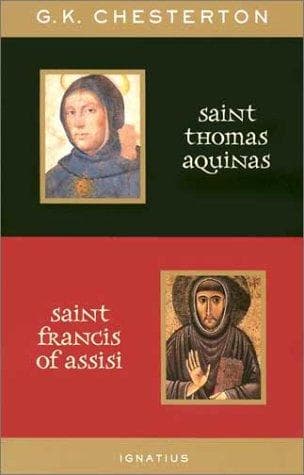
St. Francis of AssisiChesterton, G. K. (Gilbert Keith)
Religion
St. Francis of Assisi
Chesterton, G. K. (Gilbert Keith)
Francis, of Assisi, Saint, 1182-1226
Rome rose at the expense of her Greek teachers largely because she did
not entirely consent to be taught these tricks. She had a much more
decent domestic tradition; but she ultimately suffered from the same
fallacy in her religious tradition; which was necessarily in no small
degree the heathen tradition of nature-worship. What was the matter with
the whole heathen civilisation was that there was nothing for the mass
of men in the way of mysticism, except that concerned with the mystery
of the nameless forces of nature, such as sex and growth and death. In
the Roman Empire also, long before the end, we find nature-worship
inevitably producing things that are against nature. Cases like that of
Nero have passed into a proverb, when Sadism sat on a throne brazen in
the broad daylight. But the truth I mean is something much more subtle
and universal than a conventional catalogue of atrocities. What had
happened to the human imagination, as a whole, was that the whole world
was coloured by dangerous and rapidly deteriorating passions; by natural
passions becoming unnatural passions. Thus the effect of treating sex as
only one innocent natural thing was that every other innocent natural
thing became soaked and sodden with sex. For sex cannot be admitted to a
mere equality among elementary emotions or experiences like eating and
sleeping. The moment sex ceases to be a servant it becomes a tyrant.
There is something dangerous and disproportionate in its place in human
nature, for whatever reason; and it does really need a special
purification and dedication. The modern talk about sex being free like
any other sense, about the body being beautiful like any tree or flower,
is either a description of the Garden of Eden or a piece of thoroughly
bad psychology, of which the world grew weary two thousand years ago.
This is not to be confused with mere self-righteous sensationalism about
the wickedness of the pagan world. It was not so much that the pagan
world was wicked as that it was good enough to realise that its paganism
was becoming wicked, or rather was on the logical high road to
wickedness. I mean that there was no future for "natural magic"; to
deepen it was only to darken it into black magic. There was no future
for it; because in the past it had only been innocent because it was
young. We might say it had only been innocent because it was shallow.
Pagans were wiser than paganism; that is why the pagans became
Christians. Thousands of them had philosophy and family virtues and
military honour to hold them up; but by this time the purely popular
thing called religion was certainly dragging them down. When this
reaction against the evil is allowed for, it is true to repeat that it
was an evil that was everywhere. In another and more literal sense its
name was Pan.
Public-domain text, read in full here on John Shaqi.
Reviews
Reviews
No reviews yet
Be the first to share your thoughts on this work.
Join the Discussion
Join the discussion
Sign in to leave a comment or review.
Sign InorCreate an account