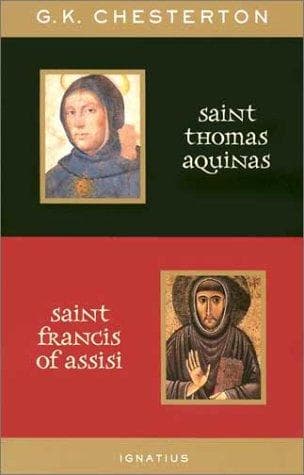
St. Francis of AssisiChesterton, G. K. (Gilbert Keith)
Religion
St. Francis of Assisi
Chesterton, G. K. (Gilbert Keith)
Francis, of Assisi, Saint, 1182-1226
Francis of Assisi was slight in figure with that sort of slightness
which, combined with so much vivacity, gives the impression of
smallness. He was probably taller than he looked; middle-sized, his
biographers say; he was certainly very active and, considering what he
went through, must have been tolerably tough. He was of the brownish
Southern colouring, with a dark beard thin and pointed such as appears
in pictures under the hoods of elves; and his eyes glowed with the fire
that fretted him night and day. There is something about the description
of all he said and did which suggests that, even more than most
Italians, he turned naturally to a passionate pantomime of gestures. If
this was so it is equally certain that with him, even more than with
most Italians, the gestures were all gestures of politeness or
hospitality. And both these facts, the vivacity and the courtesy, are
the outward signs of something that mark him out very distinctively from
many who might appear to be more of his kind than they really are. It is
truly said that Francis of Assisi was one of the founders of the
medieval drama, and therefore of the modern drama. He was the very
reverse of a theatrical person in the selfish sense; but for all that he
was pre-eminently a dramatic person. This side of him can best be
suggested by taking what is commonly regarded as a reposeful quality;
what is commonly described as a love of nature. We are compelled to use
the term; and it is entirely the wrong term.
St. Francis was not a lover of nature. Properly understood, a lover of
nature was precisely what he was not. The phrase implies accepting the
material universe as a vague environment, a sort of sentimental
pantheism. In the romantic period of literature, in the age of Byron and
Scott, it was easy enough to imagine that a hermit in the ruins of a
chapel (preferably by moonlight) might find peace and a mild pleasure in
the harmony of solemn forests and silent stars, while he pondered over
some scroll or illuminated volume, about the liturgical nature of which
the author was a little vague. In short, the hermit might love nature as
a background. Now for St. Francis nothing was ever in the background. We
might say that his mind had no background, except perhaps that divine
darkness out of which the divine love had called up every coloured
creature one by one. He saw everything as dramatic, distinct from its
setting, not all of a piece like a picture but in action like a play. A
bird went by him like an arrow; something with a story and a purpose,
though it was a purpose of life and not a purpose of death. A bush could
stop him like a brigand; and indeed he was as ready to welcome the
brigand as the bush.
Public-domain text, read in full here on John Shaqi.
Reviews
Reviews
No reviews yet
Be the first to share your thoughts on this work.
Join the Discussion
Join the discussion
Sign in to leave a comment or review.
Sign InorCreate an account