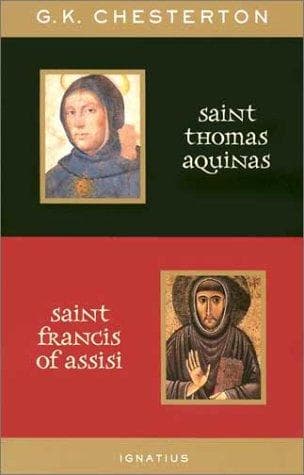
St. Francis of AssisiChesterton, G. K. (Gilbert Keith)
Religion
St. Francis of Assisi
Chesterton, G. K. (Gilbert Keith)
Francis, of Assisi, Saint, 1182-1226
This rough outline can only be rounded off here with some description of
the Second and Third Orders, though they were founded later and at
separate times. The former was an order for women and owed its
existence, of course, to the beautiful friendship of St. Francis and
St. Clare. There is no story about which even the most sympathetic
critics of another creed have been more bewildered and misleading. For
there is no story that more clearly turns on that simple test which I
have taken as crucial throughout this criticism. I mean that what is the
matter with these critics is that they will not believe that a heavenly
love can be as real as an earthly love. The moment it is treated as
real, like an earthly love, their whole riddle is easily resolved. A
girl of seventeen, named Clare and belonging to one of the noble
families of Assisi, was filled with an enthusiasm for the conventual
life; and Francis helped her to escape from her home and to take up the
conventual life. If we like to put it so, he helped her to elope into
the cloister, defying her parents as he had defied his father. Indeed
the scene had many of the elements of a regular romantic elopement; for
she escaped through a hole in the wall, fled through a wood and was
received at midnight by the light of torches. Even Mrs. Oliphant, in her
fine and delicate study of St. Francis, calls it "an incident which we
can hardly record with satisfaction."
Now about that incident I will here only say this. If it had really been
a romantic elopement and the girl had become a bride instead of a nun,
practically the whole modern world would have made her a heroine. If the
action of the Friar towards Clare had been the action of the Friar
towards Juliet, everybody would be sympathising with her exactly as they
sympathise with Juliet. It is not conclusive to say that Clare was only
seventeen. Juliet was only fourteen. Girls married and boys fought in
battles at such early ages in medieval times; and a girl of seventeen in
the thirteenth century was certainly old enough to know her own mind.
There cannot be the shadow of a doubt, for any sane person considering
subsequent events, that St. Clare did know her own mind. But the point
for the moment is that modern romanticism entirely encourages such
defiance of parents when it is done in the name of romantic love. For it
knows that romantic love is a reality, but it does not know that divine
love is a reality. There may have been something to be said for the
parents of Clare; there may have been something to be said for Peter
Bernardone. So there may have been a great deal to be said for the
Montagues or the Capulets; but the modern world does not want it said;
and does not say it. The fact is that as soon as we assume for a moment
as a hypothesis, what St. Francis and St. Clare assumed all the time as
an absolute, that there is a direct divine relation more glorious than
any romance, the story of St. Clare's elopement is simply a romance with
Public-domain text, read in full here on John Shaqi.
Reviews
Reviews
No reviews yet
Be the first to share your thoughts on this work.
Elsewhere in the archive
Join the Discussion
Join the discussion
Sign in to leave a comment or review.
Sign InorCreate an account