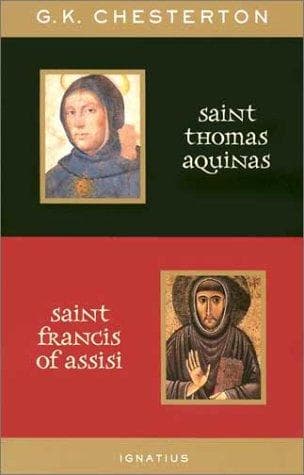
St. Francis of AssisiChesterton, G. K. (Gilbert Keith)
Religion
St. Francis of Assisi
Chesterton, G. K. (Gilbert Keith)
Francis, of Assisi, Saint, 1182-1226
a happy ending; and St. Francis is the St. George or knight-errant who
gave it a happy ending. And seeing that some millions of men and women
have lived and died treating this relation as a reality, a man is not
much of a philosopher if he cannot even treat it as a hypothesis.
For the rest, we may at least assume that no friend of what is called
the emancipation of women will regret the revolt of St. Clare. She did
most truly, in the modern jargon, live her own life, the life that she
herself wanted to lead, as distinct from the life into which parental
commands and conventional arrangements would have forced her. She became
the foundress of a great feminine movement which still profoundly
affects the world; and her place is with the powerful women of history.
It is not clear that she would have been so great or so useful if she
had made a runaway match, or even stopped at home and made a _mariage de
convenance_. So much any sensible man may well say considering the
matter merely from the outside; and I have no intention of attempting to
consider it from the inside. If a man may well doubt whether he is
worthy to write a word about St. Francis, he will certainly want words
better than his own to speak of the friendship of St. Francis and
St. Clare. I have often remarked that the mysteries of this story are
best expressed symbolically in certain silent attitudes and actions. And
I know no better symbol than that found by the felicity of popular
legend, which says that one night the people of Assisi thought the trees
and the holy house were on fire, and rushed up to extinguish the
conflagration. But they found all quiet within, where St. Francis broke
bread with St. Clare at one of their rare meetings, and talked of the
love of God. It would be hard to find a more imaginative image, for some
sort of utterly pure and disembodied passion, than that red halo round
the unconscious figures on the hill; a flame feeding on nothing and
setting the very air on fire.
Public-domain text, read in full here on John Shaqi.
Reviews
Reviews
No reviews yet
Be the first to share your thoughts on this work.
Elsewhere in the archive
Join the Discussion
Join the discussion
Sign in to leave a comment or review.
Sign InorCreate an account