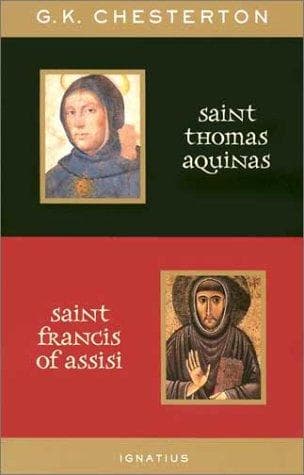
St. Francis of AssisiChesterton, G. K. (Gilbert Keith)
Religion
St. Francis of Assisi
Chesterton, G. K. (Gilbert Keith)
Francis, of Assisi, Saint, 1182-1226
Now in truth while it has always seemed natural to explain St. Francis
in the light of Christ, it has not occurred to many people to explain
Christ in the light of St. Francis. Perhaps the word "light" is not here
the proper metaphor; but the same truth is admitted in the accepted
metaphor of the mirror. St. Francis is the mirror of Christ rather as
the moon is the mirror of the sun. The moon is much smaller than the
sun, but it is also much nearer to us; and being less vivid it is more
visible. Exactly in the same sense St. Francis is nearer to us, and
being a mere man like ourselves is in that sense more imaginable. Being
necessarily less of a mystery, he does not, for us, so much open his
mouth in mysteries. Yet as a matter of fact, many minor things that seem
mysteries in the mouth of Christ would seem merely characteristic
paradoxes in the mouth of St. Francis. It seems natural to re-read the
more remote incidents with the help of the more recent ones. It is a
truism to say that Christ lived before Christianity; and it follows that
as an historical figure He is a figure in heathen history. I mean that
the medium in which He moved was not the medium of Christendom but of
the old pagan empire; and from that alone, not to mention the distance
of time, it follows that His circumstances are more alien to us than
those of an Italian monk such as we might meet even to-day. I suppose
the most authoritative commentary can hardly be certain of the current
or conventional weight of all His words or phrases; of which of them
would then have seemed a common allusion and which a strange fancy. This
archaic setting has left many of the sayings standing like hieroglyphics
and subject to many and peculiar individual interpretations. Yet it is
true of almost any of them that if we simply translate them into the
Umbrian dialect of the first Franciscans, they would seem like any other
part of the Franciscan story; doubtless in one sense fantastic, but
quite familiar. All sorts of critical controversies have revolved round
the passage which bids men consider the lilies of the field and copy
them in taking no thought for the morrow. The sceptic has alternated
between telling us to be true Christians and do it, and explaining that
it is impossible to do. When he is a communist as well as an atheist, he
is generally doubtful whether to blame us for preaching what is
impracticable or for not instantly putting it into practice. I am not
going to discuss here the point of ethics and economics; I merely remark
that even those who are puzzled at the saying of Christ would hardly
pause in accepting it as a saying of St. Francis. Nobody would be
surprised to find that he had said, "I beseech you, little brothers,
that you be as wise as Brother Daisy and Brother Dandelion; for never do
they lie awake thinking of to-morrow, yet they have gold crowns like
kings and emperors or like Charlemagne in all his glory." Even more
Public-domain text, read in full here on John Shaqi.
Reviews
Reviews
No reviews yet
Be the first to share your thoughts on this work.
Elsewhere in the archive
Join the Discussion
Join the discussion
Sign in to leave a comment or review.
Sign InorCreate an account