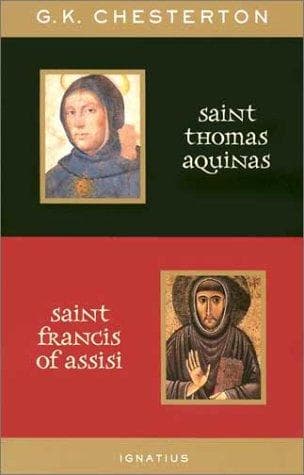
St. Francis of AssisiChesterton, G. K. (Gilbert Keith)
Religion
St. Francis of Assisi
Chesterton, G. K. (Gilbert Keith)
Francis, of Assisi, Saint, 1182-1226
No man who has been given the freedom of the Faith is likely to fall
into those hole-and-corner extravagances in which later degenerate
Franciscans, or rather Fraticelli, sought to concentrate entirely on
St. Francis as a second Christ, the creator of a new gospel. In fact any
such notion makes nonsense of every motive in the man's life; for no man
would reverently magnify what he was meant to rival, or only profess to
follow what he existed to supplant. On the contrary, as will appear
later, this little study would rather specially insist that it was
really the papal sagacity that saved the great Franciscan movement for
the whole world and the universal Church, and prevented it from petering
out as that sort of stale and second-rate sect that is called a new
religion. Everything that is written here must be understood not only as
distinct from but diametrically opposed to the idolatry of the
Fraticelli. The difference between Christ and St. Francis was the
difference between the Creator and the creature; and certainly no
creature was ever so conscious of that colossal contrast as St. Francis
himself. But subject to this understanding, it is perfectly true and it
is vitally important that Christ was the pattern on which St. Francis
sought to fashion himself; and that at many points their human and
historical lives were even curiously coincident; and above all, that
compared to most of us at least St. Francis is a most sublime
approximation to his Master, and, even in being an intermediary and a
reflection, is a splendid and yet a merciful Mirror of Christ. And this
truth suggests another, which I think has hardly been noticed; but which
happens to be a highly forcible argument for the authority of Christ
being continuous in the Catholic Church.
Cardinal Newman wrote in his liveliest controversial work a sentence
that might be a model of what we mean by saying that his creed tends to
lucidity and logical courage. In speaking of the ease with which truth
may be made to look like its own shadow or sham, he said, "And if
Antichrist is like Christ, Christ I suppose is like Antichrist." Mere
religious sentiment might well be shocked at the end of the sentence;
but nobody could object to it except the logician who said that Cæsar
and Pompey were very much alike, especially Pompey. It may give a much
milder shock if I say here, what most of us have forgotten, that if
St. Francis was like Christ, Christ was to that extent like St. Francis.
And my present point is that it is really very enlightening to realise
that Christ was like St. Francis. What I mean is this; that if men find
certain riddles and hard sayings in the story of Galilee, and if they
find the answers to those riddles in the story of Assisi, it really does
show that a secret has been handed down in one religious tradition and
no other. It shows that the casket that was locked in Palestine can be
unlocked in Umbria; for the Church is the keeper of the keys.
Public-domain text, read in full here on John Shaqi.
Reviews
Reviews
No reviews yet
Be the first to share your thoughts on this work.
Elsewhere in the archive
Join the Discussion
Join the discussion
Sign in to leave a comment or review.
Sign InorCreate an account