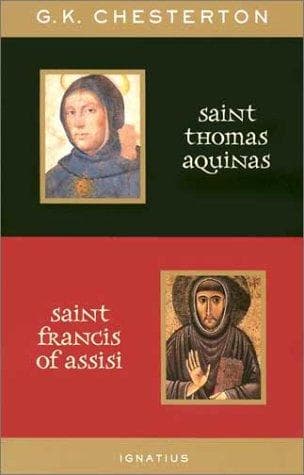
St. Francis of AssisiChesterton, G. K. (Gilbert Keith)
Religion
St. Francis of Assisi
Chesterton, G. K. (Gilbert Keith)
Francis, of Assisi, Saint, 1182-1226
Christianity. But it is the ancient Church that can again startle the
world with the paradoxes of Christianity. _Ubi Petrus ibi Franciscus._
But if we understand that it was truly under the inspiration of his
divine Master that St. Francis did these merely quaint or eccentric acts
of charity, we must understand that it was under the same inspiration
that he did acts of self-denial and austerity. It is clear that these
more or less playful parables of the love of men were conceived after a
close study of the Sermon on the Mount. But it is evident that he made
an even closer study of the silent sermon on that other mountain; the
mountain that was called Golgotha. Here again he was speaking the strict
historical truth, when he said that in fasting or suffering humiliation
he was but trying to do something of what Christ did; and here again it
seems probable that as the same truth appears at the two ends of a chain
of tradition, the tradition has preserved the truth. But the import of
this fact at the moment affects the next phase in the personal history
of the man himself.
For as it becomes clearer that his great communal scheme is an
accomplished fact and past the peril of an early collapse, as it becomes
evident that there already is such a thing as an Order of the Friars
Minor, this more individual and intense ambition of St. Francis emerges
more and more. So soon as he certainly has followers, he does not
compare himself with his followers, towards whom he might appear as a
master; he compares himself more and more with his Master, towards whom
he appears only as a servant. This, it may be said in passing, is one of
the moral and even practical conveniences of the ascetical privilege.
Every other sort of superiority may be superciliousness. But the saint
is never supercilious, for he is always by hypothesis in the presence of
a superior. The objection to an aristocracy is that it is a priesthood
without a god. But in any case the service to which St. Francis had
committed himself was one which, about this time, he conceived more and
more in terms of sacrifice and crucifixion. He was full of the sentiment
that he had not suffered enough to be worthy even to be a distant
follower of his suffering God. And this passage in his history may
really be roughly summarised as the Search for Martyrdom.
Public-domain text, read in full here on John Shaqi.
Reviews
Reviews
No reviews yet
Be the first to share your thoughts on this work.
Elsewhere in the archive
Join the Discussion
Join the discussion
Sign in to leave a comment or review.
Sign InorCreate an account