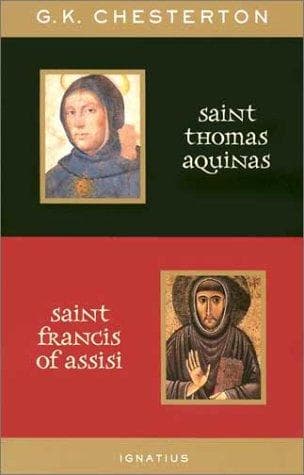
St. Francis of AssisiChesterton, G. K. (Gilbert Keith)
Religion
St. Francis of Assisi
Chesterton, G. K. (Gilbert Keith)
Francis, of Assisi, Saint, 1182-1226
This was the ultimate idea in the remarkable business of his expedition
among the Saracens in Syria. There were indeed other elements in his
conception, which are worthy of more intelligent understanding than they
have often received. His idea, of course, was to bring the Crusades in a
double sense to their end; that is, to reach their conclusion and to
achieve their purpose. Only he wished to do it by conversion and not by
conquest; that is, by intellectual and not material means. The modern
mind is hard to please; and it generally calls the way of Godfrey
ferocious and the way of Francis fanatical. That is, it calls any moral
method unpractical, when it has just called any practical method
immoral. But the idea of St. Francis was far from being a fanatical or
necessarily even an unpractical idea; though perhaps he saw the problem
as rather too simple, lacking the learning of his great inheritor
Raymond Lully, who understood more but has been quite as little
understood. The way he approached the matter was indeed highly personal
and peculiar; but that was true of almost everything he did. It was in
one way a simple idea, as most of his ideas were simple ideas. But it
was not a silly idea; there was a great deal to be said for it and it
might have succeeded. It was, of course, simply the idea that it is
better to create Christians than to destroy Moslems. If Islam had been
converted, the world would have been immeasurably more united and happy;
for one thing, three quarters of the wars of modern history would never
have taken place. It was not absurd to suppose that this might be
effected, without military force, by missionaries who were also martyrs.
The Church had conquered Europe in that way and may yet conquer Asia or
Africa in that way. But when all this is allowed for, there is still
another sense in which St. Francis was not thinking of Martyrdom as a
means to an end, but almost as an end in itself; in the sense that to
him the supreme end was to come closer to the example of Christ. Through
all his plunging and restless days ran the refrain: I have not suffered
enough; I have not sacrificed enough; I am not yet worthy even of the
shadow of the crown of thorns. He wandered about the valleys of the
world looking for the hill that has the outline of a skull.
Public-domain text, read in full here on John Shaqi.
Reviews
Reviews
No reviews yet
Be the first to share your thoughts on this work.
Elsewhere in the archive
Join the Discussion
Join the discussion
Sign in to leave a comment or review.
Sign InorCreate an account