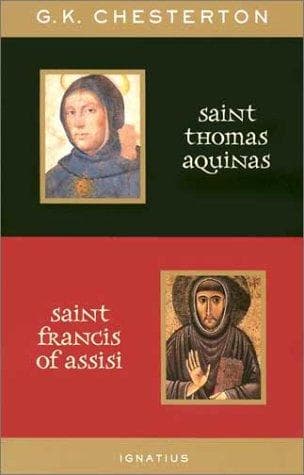
St. Francis of AssisiChesterton, G. K. (Gilbert Keith)
Religion
St. Francis of Assisi
Chesterton, G. K. (Gilbert Keith)
Francis, of Assisi, Saint, 1182-1226
such a leisurely manner of patronising the drama may be recommended. To
those tormented by a merely intellectual curiosity about who is kissing
or killing whom, and why, it is unsatisfactory.
Most modern history, especially in England, suffers from the same
imperfection as journalism. At best it only tells half of the history of
Christendom; and that the second half without the first half. Men for
whom reason begins with the Revival of Learning, men for whom religion
begins with the Reformation, can never give a complete account of
anything, for they have to start with institutions whose origin they
cannot explain, or generally even imagine. Just as we hear of the
admiral being shot but have never heard of his being born, so we all
heard a great deal about the dissolution of the monasteries, but we
heard next to nothing about the creation of the monasteries. Now this
sort of history would be hopelessly insufficient, even for an
intelligent man who hated the monasteries. It is hopelessly insufficient
in connection with institutions that many intelligent men do in a quite
healthy spirit hate. For instance, it is possible that some of us have
occasionally seen some mention, by our learned leader-writers, of an
obscure institution called the Spanish Inquisition. Well, it really is
an obscure institution, according to them and the histories they read.
It is obscure because its origin is obscure. Protestant history simply
begins with the horrible thing in possession, as the pantomime begins
with the demon king in the goblin kitchen. It is likely enough that it
was, especially towards the end, a horrible thing that might be haunted
by demons; but if we say this was so, we have no notion why it was so.
To understand the Spanish Inquisition it would be necessary to discover
two things that we have never dreamed of bothering about; what Spain was
and what an Inquisition was. The former would bring in the whole great
question about the Crusade against the Moors; and by what heroic
chivalry a European nation freed itself of an alien domination from
Africa. The latter would bring in the whole business of the other
Crusade against the Albigensians, and why men loved and hated that
nihilistic vision from Asia. Unless we understand that there was in
these things originally the rush and romance of a Crusade, we cannot
understand how they came to deceive men or drag them on towards evil.
The Crusaders doubtless abused their victory, but there was a victory to
abuse. And where there is victory there is valour in the field and
popularity in the forum. There is some sort of enthusiasm that
encourages excesses or covers faults. For instance, I for one have
maintained from very early days the responsibility of the English for
their atrocious treatment of the Irish. But it would be quite unfair to
the English to describe even the devilry of '98 and leave out altogether
all mention of the war with Napoleon. It would be unjust to suggest that
Public-domain text, read in full here on John Shaqi.
Reviews
Reviews
No reviews yet
Be the first to share your thoughts on this work.
Join the Discussion
Join the discussion
Sign in to leave a comment or review.
Sign InorCreate an account