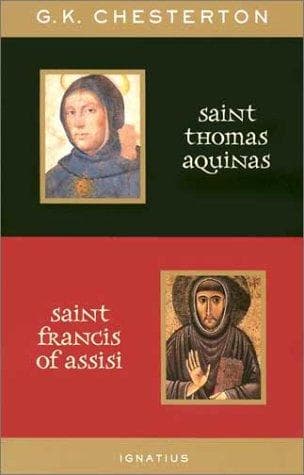
St. Francis of AssisiChesterton, G. K. (Gilbert Keith)
Religion
St. Francis of Assisi
Chesterton, G. K. (Gilbert Keith)
Francis, of Assisi, Saint, 1182-1226
It is perhaps the chief suggestion of this book that St. Francis walked
the world like the Pardon of God. I mean that his appearance marked the
moment when men could be reconciled not only to God but to nature and,
most difficult of all, to themselves. For it marked the moment when all
the stale paganism that had poisoned the ancient world was at last
worked out of the social system. He opened the gates of the Dark Ages as
of a prison of purgatory, where men had cleansed themselves as hermits
in the desert or heroes in the barbarian wars. It was in fact his whole
function to tell men to start afresh and, in that sense, to tell them to
forget. If they were to turn over a new leaf and begin a fresh page with
the first large letters of the alphabet, simply drawn and brilliantly
coloured in the early medieval manner, it was clearly a part of that
particular childlike cheerfulness that they should paste down the old
page that was all black and bloody with horrid things. For instance, I
have already noted that there is not a trace in the poetry of this first
Italian poet of all that pagan mythology which lingered long after
paganism. The first Italian poet seems the only man in the world who has
never even heard of Virgil. This was exactly right for the special sense
in which he is the first Italian poet. It is quite right that he should
call a nightingale a nightingale, and not have its song spoilt or
saddened by the terrible tales of Itylus or Procne. In short, it is
really quite right and quite desirable that St. Francis should never
have heard of Virgil. But do we really desire that Dante should never
have heard of Virgil? Do we really desire that Dante should never have
read any pagan mythology? It has been truly said that the use that Dante
makes of such fables is altogether part of a deeper orthodoxy; that his
huge heathen fragments, his gigantic figures of Minos or of Charon, only
give a hint of some enormous natural religion behind all history and
from the first foreshadowing the Faith. It is well to have the Sybil as
well as David in the Dies Irae. That St. Francis would have burned all
the leaves of all the books of the Sybil, in exchange for one fresh leaf
from the nearest tree, is perfectly true; and perfectly proper to
St. Francis. But it is good to have the Dies Irae as well as the
Canticle of the Sun.
Public-domain text, read in full here on John Shaqi.
Reviews
Reviews
No reviews yet
Be the first to share your thoughts on this work.
Elsewhere in the archive
Join the Discussion
Join the discussion
Sign in to leave a comment or review.
Sign InorCreate an account