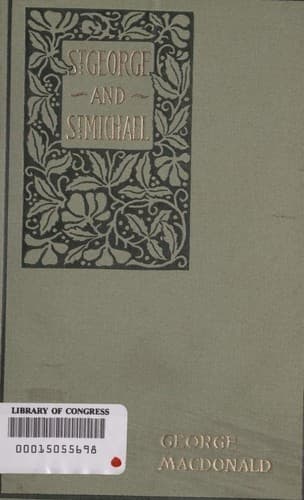
Great Britain -- History -- Civil War, 1642-1649 -- Fiction
Presently the woman came running back, followed at a more leisurely pace
by Goody Rees, whose countenance was grave, and, even to the twitch
about her mouth, inscrutable. She walked up to where the man lay, looked
at him for a moment or two as if considering his case, then sat down on
the ground beside him, and requested Richard to move him so that his
head should lie on her lap. This done, she laid hold of it, with a hand
on each ear, and pulled at his neck, at the same time turning his head
in the right direction. There came a snap, and the neck was straight.
She then began to stroke it with gentle yet firm hand. In a few moments
he began to breathe. As soon as she saw his chest move, she called for a
wisp of hay, and having shaped it a little, drew herself from under his
head, substituting the hay. Then rising without a word she walked from
the yard. Stopchase lay for a while, gradually coming to himself, then
scrambled all at once to his feet, and staggered to his pitchfork, which
lay where it had fallen. 'It is of the mercy of the Lord that I fell not
upon the prongs of the pitchfork,' he said, as he slowly stooped and
lifted it. He had no notion that he had lain more than a few seconds;
and of the return of Goody Rees and her ministrations he knew nothing;
while such an awe of herself and her influences had she left behind her,
that neither the woman nor the cow-boy ventured to allude to her, and
even Richard, influenced partly, no doubt, by late reading, was more
inclined to think than speak about her. For the man himself, little
knowing how close death had come to him, but inwardly reproached because
of his passionate outbreak, he firmly believed that he had had a narrow
escape from the net of the great fowler, whose decoy the old woman was,
commissioned not only to cause his bodily death, but to work in him
first such a frame of mind as should render his soul the lawful prey of
the enemy.
CHAPTER IV.
A CHAPTER OF FOOLS.
The same afternoon, as it happened, a little company of rustics, who had
just issued from the low hatch-door of the village inn, stood for a
moment under the sign of the Crown and Mitre, which swung huskily
creaking from the bough of an ancient thorn tree, then passed on to the
road, and took their way together.
'Hope you then,' said one of them, as continuing their previous
conversation, 'that we shall escape unhurt? It is a parlous business.
Not as one of us is afeard as I knows on. But the old earl, he do have a
most unregenerate temper, and you had better look to 't, my masters.'
'I tell thee, master Upstill, it's not the old earl as I'm afeard on,
but the young lord. For thou knows as well as ere a one it be not
without cause that men do call him a wizard, for a wizard he be, and
that of the worst sort.'
'We shall be out again afore sundown, shannot we?' said another. 'That I
trust.'
'Up to the which hour the High Court of Parliament assembled will have
power to protect its own--eh, John Croning?'
Public-domain text, read in full here on John Shaqi.
Reviews
Reviews
No reviews yet
Be the first to share your thoughts on this work.
Join the Discussion
Join the discussion
Sign in to leave a comment or review.
Sign InorCreate an account