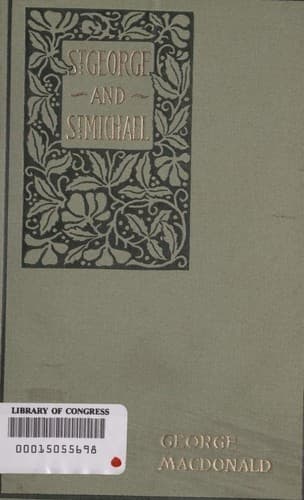
Great Britain -- History -- Civil War, 1642-1649 -- Fiction
When Dorothy reached the house, she did not run up to her room that she
might weep unseen. She was still too much annoyed with Richard to regret
having taken such leave of him. She only swallowed down a little
balloonful of sobs, and went straight into the parlour, where her mother
and Mr. Herbert still sat, and resumed her seat in the bay window. Her
heightened colour, an occasional toss of her head backwards, like that
with which a horse seeks ease from the bearing-rein, generally followed
by a renewal of the attempt to swallow something of upward tendency,
were the only signs of her discomposure, and none of them were observed
by her mother or her guest. Could she have known, however, what feelings
had already begun to rouse themselves in the mind of him whose
boyishness was an offence to her, she would have found it more difficult
to keep such composure.
Dorothy's was a face whose forms were already so decided that, should no
softening influences from the central regions gain the ascendancy,
beyond a doubt age must render it hard and unlovely. In all the
roundness and freshness of girlhood, it was handsome rather than
beautiful, beautiful rather than lovely. And yet it was strongly
attractive, for it bore clear indication of a nature to be trusted. If
her grey eyes were a little cold, they were honest eyes, with a rare
look of steadfastness; and if her lips were a little too closely
pressed, it was clearly from any cause rather than bad temper. Neither
head, hands, nor feet were small, but they were fine in form and
movement; and for the rest of her person, tall and strong as Richard
was, Dorothy looked further advanced in the journey of life than he.
Public-domain text, read in full here on John Shaqi.
Reviews
Reviews
No reviews yet
Be the first to share your thoughts on this work.
Join the Discussion
Join the discussion
Sign in to leave a comment or review.
Sign InorCreate an account