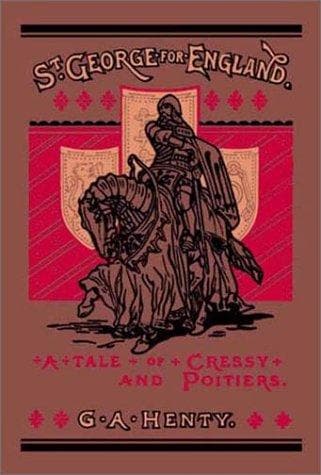
St. George for EnglandHenty, G. A. (George Alfred)
History
St. George for England
Henty, G. A. (George Alfred)
Great Britain -- History -- Edward III, 1327-1377 -- Fiction
Sir Walter presented him on leaving with a heavy purse. “Your expenses
will be large,” he said, “among so many young gallants, and you must do
credit to me as well as to yourself. The young prince is generous to a
fault, and as he holds you in high favour, both from his knowledge of
you and from my report, you will, I know, lack nothing when you are once
fairly embarked in his service; but it is needful that when you first
join you should be provided with many suits of courtly raiment, of cloth
of gold and silk, which were not needed while you were in the service
of a simple knight like myself, but which must be worn by a companion of
the heir of England.”
Walter had hoped that Sir James Carnegie would have accompanied the
forces of either the Earls of Northampton or Derby, but he found that he
had attached himself to the royal army.
Ralph of course followed Walter's fortunes, and was now brilliant in the
appointments of the Prince of Wales's chosen bodyguard of men-at-arms.
The councils of all the great towns of Flanders assembled at Sluys, and
for several days great festivities were held. Then a great assembly was
held, and Van Artevelde rose and addressed his countrymen. He set forth
to them the virtues of the Prince of Wales, whose courtesy and bearing
had so captivated them; he pointed out the obligations which Flanders
was under towards King Edward, and the advantages which would arise from
a nearer connection with England. With this he contrasted the weakness
of their count, the many ills which his adherence to France had brought
upon the country, and the danger which menaced them should his power be
ever renewed. He then boldly proposed to them that they should at once
cast off their allegiance to the count and bestow the vacant coronet
upon the Prince of Wales, who, as Duke of Flanders, would undertake the
defence and government of the country with the aid of a Flemish
council. This wholly unexpected proposition took the Flemish burghers
by surprise. Artevelde had calculated upon his eloquence and influence
carrying them away, but his power had diminished, and many of his
hearers had already been gained to the cause of France. The burgher
councils had for a long time had absolute power in their own towns, and
the prospect of a powerful prince at their head foredoomed a curtailment
of those powers. When Artevelde ceased, therefore, instead of the
enthusiastic shouts with which he hoped his oration would be greeted,
a confused murmur arose. At last several got up and said that, greatly
attached as they were to the king, much as they admired the noble young
prince proposed for their acceptance, they felt themselves unable to
give an answer upon an affair of such moment without consulting their
fellow countrymen and learning their opinions. They therefore promised
that they would return on a certain day and give a decided answer.
Public-domain text, read in full here on John Shaqi.
Reviews
Reviews
No reviews yet
Be the first to share your thoughts on this work.
Elsewhere in the archive
Join the Discussion
Join the discussion
Sign in to leave a comment or review.
Sign InorCreate an account