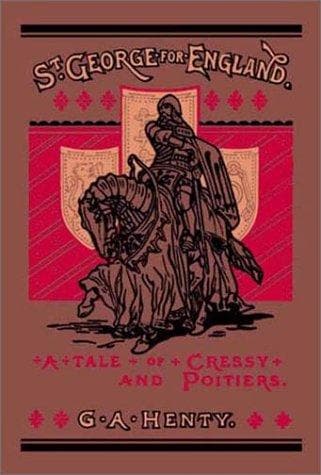
St. George for EnglandHenty, G. A. (George Alfred)
History
St. George for England
Henty, G. A. (George Alfred)
Great Britain -- History -- Edward III, 1327-1377 -- Fiction
The Flemish burghers then took their leave. Van Artevelde, after a
consultation with the king, started at once to use his influence among
the various towns.
After leaving the king he bade adieu to the Prince of Wales. “Would you
like,” the young prince said, “that one of my esquires should ride with
you? His presence might show the people how entirely I am with you; and
should you have tidings to send me he could ride hither with them. I
have one with me who is prudent and wise, and who possesses all the
confidence of that wise and valiant knight, Sir Walter de Manny.”
“I will gladly take him, your royal highness,” Van Artevelde said, “and
hope to despatch him to you very shortly with the news that the great
towns of Flanders all gladly receive you as their lord.”
In a few minutes Walter had mounted his horse, accompanied by Ralph,
and, joining Van Artevelde, rode to Bruges. Here and at Ypres Van
Artevelde's efforts were crowned with success. His eloquence carried
away the people with him, and both these cities agreed to accept the
Prince of Wales as their lord; but the hardest task yet remained. Ghent
was the largest and most powerful of the Flemish towns, and here his
enemies were in the ascendant. Gerard Denis and the weavers had been
stirring up the people against him. All kinds of accusations had been
spread, and he was accused of robbing and selling his country. The news
of the hostile feeling of the population reached Van Artevelde, and
he despatched Walter with the request to the king for a force of five
hundred English soldiers as a guard against his enemies.
Had Artevelde asked for a large force, Edward would have disembarked his
army and marched at their head into Ghent. As the rest of the country
was already won, there can be little doubt that this step would at once
have silenced all opposition, and would have annexed Flanders to the
British crown. Van Artevelde, however, believed himself to be stronger
than he really was, and thought with a small party of soldiers he could
seize his principal opponents, and that the people would then rally
round him.
Upon the arrival of the five hundred men he started for Ghent; but as
he feared that the gates would be shut if he presented himself with an
armed force, he left the soldiers in concealment a short distance from
the town and entered it, accompanied only by his usual suite. At his
invitation, however, Walter, followed of course by Ralph, rode beside
him. No sooner was he within the gates than Van Artevelde saw how
strong was the popular feeling against him. He had been accustomed to be
received with bows of reverence; now men turned aside as he approached,
or scowled at him from their doors.
Public-domain text, read in full here on John Shaqi.
Reviews
Reviews
No reviews yet
Be the first to share your thoughts on this work.
Elsewhere in the archive
Join the Discussion
Join the discussion
Sign in to leave a comment or review.
Sign InorCreate an account