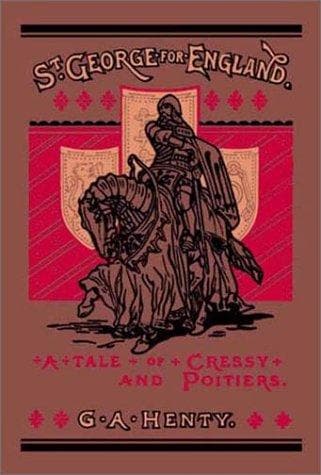
St. George for EnglandHenty, G. A. (George Alfred)
History
St. George for England
Henty, G. A. (George Alfred)
Great Britain -- History -- Edward III, 1327-1377 -- Fiction
The force was now formed into three divisions--the one commanded by
the king himself, the second by the Earl of Warwick, and the third by
Godfrey of Harcourt. The Earl of Arundel acted as Lord High Constable,
and the Earl of Huntingdon, who was in command of the fleet, followed
the army along the sea-coast. Valognes, Carentan, and St. Lo were
captured without difficulty, and the English army advanced by rapid
marches upon Caen, plundering the country for six or seven leagues
on each side of the line of march. An immense quantity of booty was
obtained. As soon as the news of Edward's landing in Normandy reached
Paris, Phillip despatched the Count d'Eu, Constable of France, with the
Count of Tankerville and 600 men-at-arms, to oppose Edward at Caen. The
Bishop of Bayeux had thrown himself into that city, which was already
garrisoned by 300 Genoese. The town was not defensible, and the only
chance of resistance was by opposing the passage of the river
Horn, which flowed between the suburbs and the city. The bridge
was barricaded, strong wooden towers were erected, and such was the
confidence of the inhabitants and their leaders that Edward's promise of
protection for the person and property of the citizens was rejected with
scorn, and the whole male population joined the garrison in the defence
of the bridge. Marching through the deserted suburbs the English army
attacked the bridge with such vehemence that although the enemy defended
the barricades gallantly they were speedily forced, and the English
poured into the town. Before the first fury of the attack was over near
5000 persons were slain. The Count of Tankerville, 140 knights, and as
many squires were made prisoners. The plunder was so enormous as to be
sufficient to cover the whole expenses of the expedition, and this with
the booty which had been previously acquired was placed on board ship
and despatched to England, while the king marched forward with his army.
At Lisieux he was met by two cardinals sent by the pope to negotiate
a truce; but Edward had learned the fallacy of truces made with King
Phillip, and declined to enter into negotiations. Finding that Rouen had
been placed in a state of defence and could not be taken without a long
siege he left it behind him and marched along the valley of the Eure,
gathering rich booty at every step.
But while he was marching forward a great army was gathering in his
rear. The Count of Harcourt brother of Godfrey, called all Normandy to
arms. Every feudal lord and vassal answered to the summons, and before
Edward reached the banks of the Seine a formidable army had assembled.
Public-domain text, read in full here on John Shaqi.
Reviews
Reviews
No reviews yet
Be the first to share your thoughts on this work.
Elsewhere in the archive
Join the Discussion
Join the discussion
Sign in to leave a comment or review.
Sign InorCreate an account