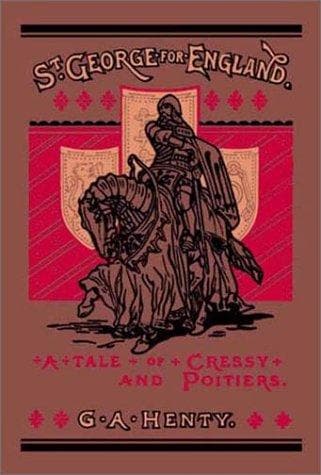
St. George for EnglandHenty, G. A. (George Alfred)
History
St. George for England
Henty, G. A. (George Alfred)
Great Britain -- History -- Edward III, 1327-1377 -- Fiction
The whole of the vassals of France were gathering by the orders of the
king at St. Denis. The English fleet had now left the coast, and Edward
had only the choice of retreating through Normandy into Brittany or
of attempting to force the passage of the Seine, and to fight his way
through France to Flanders. He chose the latter alternative, and marched
along the left bank of the river towards Paris, seeking in vain to find
a passage. The enemy followed him step by step on the opposite bank, and
all the bridges were broken down and the fords destroyed.
Edward marched on, burning the towns and ravaging the country until
he reached Poissy. The bridge was as usual destroyed, but the piles on
which it stood were still standing, and he determined to endeavour to
cross here. He accordingly halted for five days, but despatched troops
in all directions, who burned and ravaged to the very gates of Paris.
The villages of St. Germain, St. Cloud, Bourg la Reine, and many others
within sight of the walls were destroyed, and the capital itself thrown
into a state of terror and consternation. Godfrey of Harcourt was the
first to cross the river, and with the advance guard of English fell
upon a large body of the burghers of Amiens, and after a severe fight
defeated them, killing over five hundred. The king himself with his
whole force passed on the 16th of August.
Phillip, with his army, quitted St. Denis, when he heard that the
English army had passed the Seine, and by parallel marches endeavoured
to interpose between it and the borders of Flanders. As his force was
every hour increasing he despatched messengers to Edward offering him
battle within a few days on condition that he would cease to ravage the
country; but Edward declined the proposal, saying that Phillip himself
by breaking down the bridges had avoided a battle as long as he could,
but that whenever he was ready to give battle he would accept the
challenge. During the whole march the armies were within a few leagues
of each other, and constant skirmishes took place between bodies
detached from the hosts.
In some of these skirmishes Walter took part, as he and the other newly
made knights were burning to distinguish themselves. Every day the
progress of the army became more difficult, as the country people
everywhere rose against them, and several times attempted to make a
stand but were defeated with great loss. The principal towns were found
deserted, and even Poix, which offered great capabilities of defence,
had been left unguarded. Upon the English entering, the burghers offered
to pay a large ransom to save the town from plunder. The money was to be
delivered as soon as the English force had withdrawn, and Walter Somers
was ordered by the king to remain behind with a few men-at-arms to
receive the ransom.
Public-domain text, read in full here on John Shaqi.
Reviews
Reviews
No reviews yet
Be the first to share your thoughts on this work.
Elsewhere in the archive
Join the Discussion
Join the discussion
Sign in to leave a comment or review.
Sign InorCreate an account